Revisiting PyVSC: Where we Stand
PyVSC started in 2019 with a simple goal: make SystemVerilog-style constrained-random stimulus and functional coverage feel as natural in Python as they do in SystemVerilog. I wrote about it in early 2020, in a series that started with Modeling Random Stimulus and Functional Coverage in Python and went on to data types, constraints and functional coverage, and in a WOSET 2020 paper that already named riscv-dv as the user that motivated it.
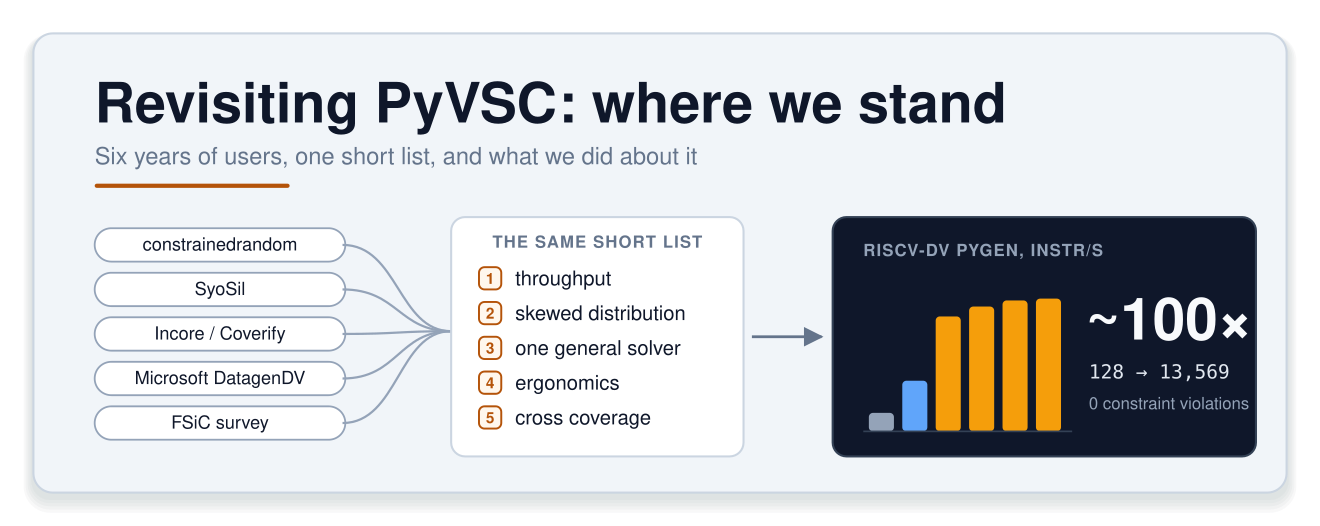
Six years on, PyVSC is widely used, and it’s also widely critiqued. What strikes me about the critiques is how specific and consistent they are. People who have never talked to each other, measuring different things, have arrived at the same short list. And, for the most part, they’re right.
This post is about that list: where PyVSC stands today, what its users have told us, what we’ve learned from it, and where the work is going. It’s the first of a series. The posts that follow go into each piece in depth, with the numbers, including the ones that point at a gap.
One promise up front, because it matters to anyone with a testbench built on
PyVSC: everything new is opt-in and additive. The classic @vsc.randobj
and @vsc.covergroup API is unchanged, and the old and new styles can be
mixed in the same file.
Where PyVSC stands
Who uses it
PyVSC gets about 64,000 downloads a month from PyPI. The GitHub repository has about 150 stars. Download counts overstate the number of people, of course. Some of that volume is riscv-dv’s CI and packages that pull PyVSC in as a dependency. Even so, it’s a sizable user base for a niche library.
A few of those users have written about it publicly, which is where most of what follows comes from:
- Microsoft’s DatagenDV uses PyVSC as its randomization engine across multiple testbenches. The DVCon paper reports that “DatagenDV has successfully saved hundreds of hours over several projects.”
- riscv-dv’s Python generator (pygen) is built on PyVSC.
- PyUVM-based work tends to reach for PyVSC by default. SyoSil chose it for a real PyUVM testbench in their open-source verification whitepaper, and academic papers (arXiv 2407.10317, arXiv 2503.11666) use it for the simple reason one of them gives: “Python as HVL does not have a covergroup. Hence, PyVSC is used.”
The newest independent measurement, SyoSil’s from 2024 against version 0.8.6, is still a fair picture of PyVSC today. The library has been stable for some time: fixes, but no change of direction. This series is about the change of direction, and it puts current numbers on the record alongside it.
What PyVSC got right
The strongest endorsement comes from the people who used PyVSC hardest. The DatagenDV team needed to bring block-level SystemVerilog constraints up to the chip level, and found:
“An instruction which contained 60 fields and 300 lines of SystemVerilog constraints was rewritten using PyVSC in a day’s time, replacing directed test case values.”
That’s the thing PyVSC was designed for: if you can write the constraint in SystemVerilog, you can write it in PyVSC with recognizably the same shape.
Other strengths come up repeatedly:
- Nested and dynamic objects. SyoSil moved their testbench off cocotb-coverage because of it: “No additional boilerplate is required to add support for randomizing nested objects.”
- Randomization and coverage in one library, with coverage exported in the standard UCIS format.
- A real solver. Tightly constrained problems get solved, and an unsatisfiable constraint set is reported as unsatisfiable rather than retried forever.
These aren’t incidental. A faster but simpler approach can’t easily add them, because each one depends on having a real constraint solver underneath. That’s why the work described in this series keeps one. The job was never to remove the solver; it was to make it fast and fair.
SyoSil’s conclusion sums up the trade-off as users saw it:
“For non-complex constraints, constrainedrandom is much faster than PyVSC, whereas PyVSC is faster at solving complex constraints. This comes at the cost of PyVSC skewing the distribution of the generated random numbers, which might prolong verification efforts as some input combinations become less likely to be generated.”
I’ve come to think of that paragraph as a good capture of the objective: keep the complex-constraint win, close the gap on simple constraints, and get rid of the skew. We’ll come back to it at the end and see how we did.
What users told us
Five independent sources have published substantive critiques of PyVSC: the constrainedrandom project, SyoSil’s whitepaper, a DVCon paper from Incore Semiconductors and Coverify, Microsoft’s DatagenDV paper, and the FSiC open-source verification survey. Lay what they say side by side and the overlap is striking.
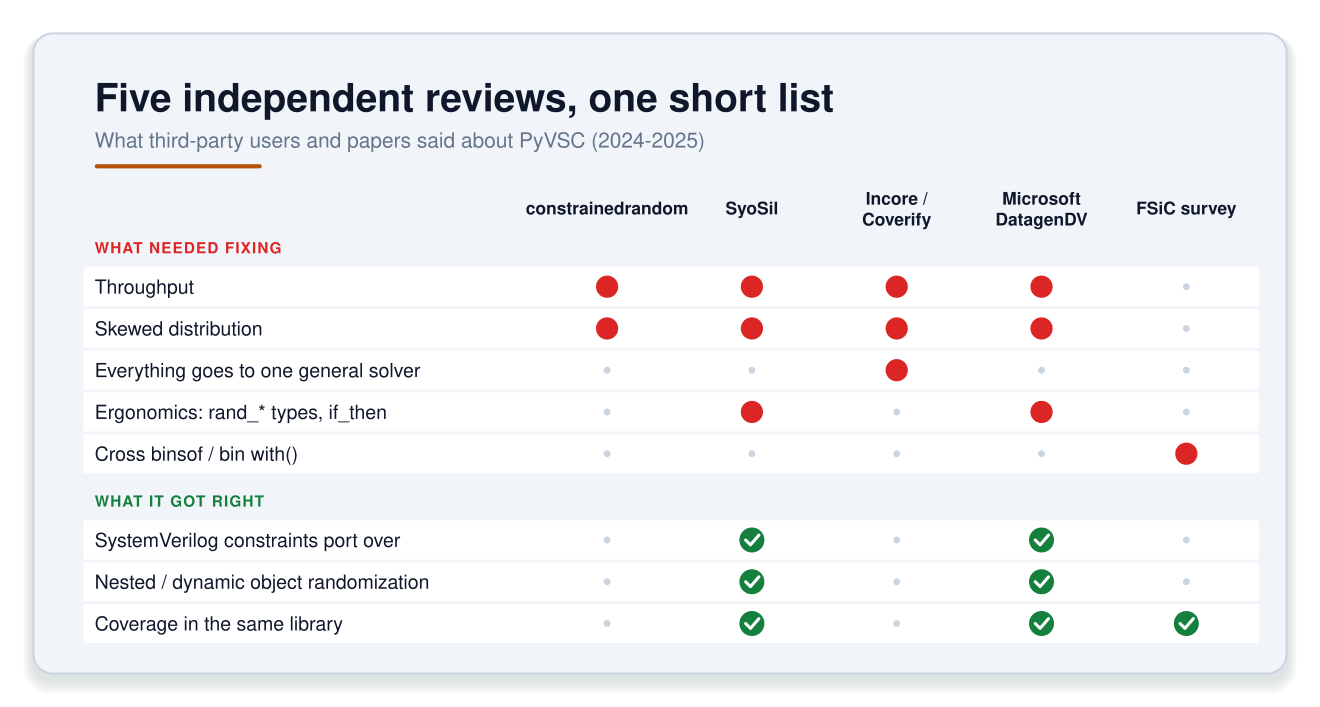
1. Throughput. constrainedrandom states its goal plainly: to “achieve at least a 10x speedup over pyvsc.” We ran their benchmark suite against stock PyVSC, and the claim is true. constrainedrandom is 26 to 426 times faster, geometric mean, depending on the workload set and whether you count first-call costs. Along the way we found three defects in the suite itself. Correcting them doesn’t rescue PyVSC. Others measured the same thing in their own settings. Incore found that pygen “generates less than a hundred random RISC-V instructions in a second,” and DatagenDV reports that 10,000 randomizations of a three-field item took roughly five minutes.
2. Distribution. SyoSil found PyVSC’s results “heavily skewed towards low
values for a and high values for b” under a simple a < b constraint. Incore
and DatagenDV report skew independently. This matters more than it might
seem. Stimulus that keeps landing on the same few values means some
combinations rarely get generated, and coverage closes more slowly.
3. Architecture. Incore goes further and names the cause: PyVSC “relies completely on Satisfiability (SAT) solvers.” There’s no fast path for the easy constraints, which are most of them.
4. Ergonomics. DatagenDV shadows every PyVSC random field with a plain
Python field, because “PyVSC’s special data types are not very easy to work
with outside of constraints.” They built a @rand_dataclass decorator to do
it automatically. SyoSil’s complaint is about the constraint language itself:
needing with vsc.if_then and with vsc.else_then “to express relatively
simple conditional relationships.”
5. Coverage modeling. The FSiC survey notes gaps in cross coverage:
binsof/intersect and with clauses.
Notice what’s not on the list. Nobody says the modeling approach is wrong, or that the coverage semantics are off. The complaints are about speed, quality and convenience, not about the model.
I want to thank everyone who wrote these up. They were detailed, reproducible and fair, and taken together they amount to a written specification for the work that followed. Here’s how that work lines up against the list:
| What users asked for | What we built | Where it’s covered |
|---|---|---|
| Throughput | dv-solve: the cheapest engine first, a complete engine for the residue | Post 2 |
| Distribution | Sampling treated as a requirement, and measured | Post 2 |
| One general solver for everything | A tiered engine, with the solver behind it | Post 2 |
Ergonomics (rand_*, if_then) |
Dataclasses, with constraints parsed rather than executed | Post 3 |
Cross coverage (binsof, with) |
Covergroups as dataclasses | Post 4 |
What we’ve learned
Looking back, classic PyVSC pays two taxes. The first is the solver: every randomization goes to a heavyweight general-purpose engine, which is built to answer a different question than the one stimulus generation asks. The second is elaboration: PyVSC rediscovers the structure of every object, every time one is created. The first two lessons below are about those taxes. The other two are about not trading correctness away to remove them.
1. Stimulus generation is not general-purpose constraint solving
An SMT solver is a decision procedure. It’s engineered to answer “is there a solution?” as quickly as possible, and to hand back whichever solution it found first. That’s exactly right for checking a property. For generating stimulus, it’s the wrong question. We don’t want a solution; we want a well-distributed random one, and a different one on every call. The first solution a solver finds is a poor sample, because solvers tend to find solutions near the boundaries of the space.
The verification workload also has a distinctive profile, and each part of it suggests something a solver can exploit:
| What the workload looks like | What a solver can do about it |
|---|---|
| The same constraint structure, solved thousands of times with new values | Compile once, then just rebind the values |
Solutions drawn one at a time, from constraints that shift (inline with, changing knobs) |
Don’t rely on batch-sampling techniques that assume a fixed problem |
| Mostly bounds, ranges and set membership, with a small residue that’s genuinely hard | Solve the easy part natively; escalate only the residue |
| Frequently independent sub-problems | Partition, and solve each separately |
| Unsatisfiable constraints must still be reported | Keep a complete engine behind the fast one |
The conclusion is that we need a a solver engine tuned to that profile, rather than a general one bent toward a job it was never intended to do. That’s the subject of the next post.
2. Structure belongs to the type, not the instance
Classic PyVSC does all of its structural work when an object is created. It scans the object to find its fields, then executes every constraint method to record what the constraints say. For the most common loop in verification (create an item, randomize it, send it, discard it, repeat) that’s backwards since every iteration rediscovers exactly the same structure.
The cost is easy to underestimate. When we profiled classic PyVSC, the native
solve was only about 12–20% of the time spent in randomize(). A faster
solver alone could never fix the rest.
The lesson I take from this is that modeling form is a performance decision. A declarative, typed model, where the structure is known once per class, is also the model that lets the library stop redoing work. Here, ergonomics and performance point in the same direction. It was encouraging to see that the DatagenDV team had independently arrived at a dataclass-based model for their own reasons.
3. Operator overloading has sharp edges, and the worst ones are silent
PyVSC’s constraint language is built on Python operator overloading. That
works for <, & and +, but Python doesn’t let a library overload and,
or, not, if, in, or chained comparisons. Hence vsc.if_then,
vsc.rangelist, and a few precedence traps around & and |.
Some of those limits produce errors. The ones that worry me are the ones that don’t. Consider:
@vsc.constraint
def c(self):
    sum(self.listvar) == 0       # quietly discarded
    self.listvar.sum == 0        # the working idiom
Python’s builtin sum() doesn’t produce a constraint, so the first line
silently constrains nothing. This isn’t hypothetical. constrainedrandom’s own
benchmark uses that form, and 193 of the 200 solutions its PyVSC baseline
produced violated the constraint. Nobody was warned. If the author of a
benchmark suite gets this wrong, users do too, and that makes it a library
problem, not a user problem.
Chained comparisons fail the same way. Python evaluates lo <= x < hi as
lo <= x and x < hi, and since and can’t be overloaded, the first half is
silently thrown away. The constraint you get is just x < hi.
The fix came from outside PyVSC. pytest has long read the source of your assertions rather than simply running them, and Zuspec’s constraint model is built on the same idea: parse, don’t execute.
4. Correct means legal and well-distributed
For stimulus, correctness has two halves. Every answer must satisfy the constraints, and the answers must cover the space the constraints allow. A generator that never draws some legal values is wrong in a way no constraint check will catch: the testbench passes, and the bug those values would have found stays hidden.
So every speed claim in this series comes with a check on both halves. The new solver’s answers can be checked against the constraints themselves and against an independent solver (z3), and distribution is measured, not assumed. When we found the new solver collapsing one constraint shape onto a single value, the fix cost 5x of throughput on that shape, and we took it. Correct and slower beats fast and wrong.
Where we’re headed
The work falls into three pieces. Each is opt-in, and each gets its own post.
A solver built for stimulus. dv-solve tries the cheapest engine first, keeps a complete engine for the hard residue, and treats distribution as a requirement rather than a side effect. Existing PyVSC code runs on it without changes, and Boolector becomes optional.
Dataclasses, with constraints parsed rather than executed. A
dataclass-based front-end (vsc.dc) where structure is established once per
class. Constraint methods are read with Python’s ast module when the class
is defined, and never executed. Chained comparisons like 0 <= x < 256,
native if/elif/else, x in [...] and x in range(...), and (as of
this week) and, or and not all mean what they say in a class
constraint. Anything the parser can’t translate is rejected when the class is
defined, with a file and line number. Builtin sum() over an array, for
example, is now an error instead of a no-op.
Covergroups as dataclasses. The same typed model applied to functional
coverage, including crosses with a working binsof.
What this enables: riscv-dv at 100x
Incore measured pygen at under 100 instructions a second. Here’s where it is now:
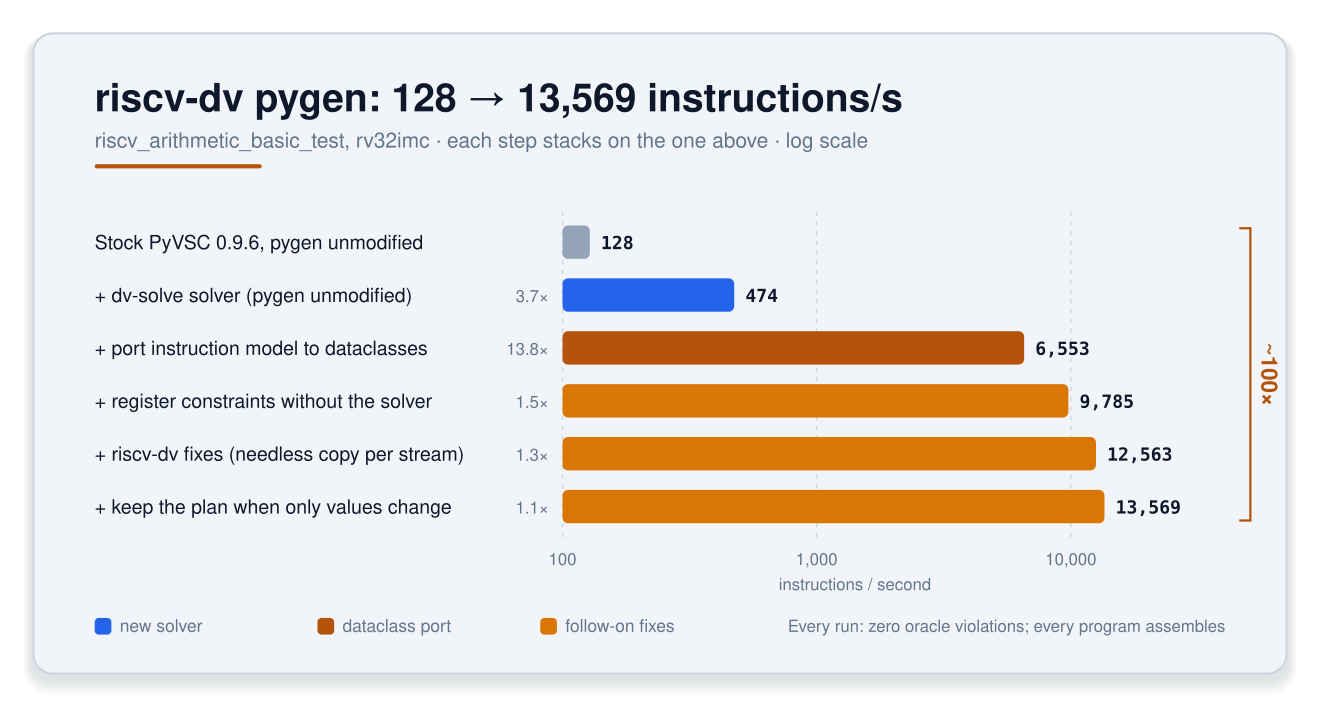
That’s about a 100x improvement, and it’s worth being clear about where it came from:
- The solver alone, with pygen unmodified, takes it from 128 to 474 instructions a second (3.7x). That’s what an existing user gets without changing any code.
- Porting pygen’s instruction model to the dataclass front-end is the biggest single step, another 13.8x.
- The rest comes from solving register-selection constraints without the solver, removing a needless copy in riscv-dv, and keeping the solve plan when only constraint values change.
Every run produced zero constraint violations under the benchmark’s checker,
and every generated program assembles. The speed-only steps leave the output
byte-identical across seeds. This is one test, riscv_arithmetic_basic_test
for rv32imc, so I’m not claiming every riscv-dv test speeds up by the same
amount. That’s the kind of thing I’d like help measuring.
On constrainedrandom’s own benchmark suite, the new stack is now 3.1x faster than constrainedrandom with warm caches and 5.2x faster cold.
Beyond Python
dv-solve isn’t tied to PyVSC. It can also run as the constraint solver behind
Verilator’s randomize(), and we’ve validated it there on riscv-dv. That gets
its own post, with numbers.
Distribution: one clear win, one open problem
The first distribution check is the shape that shows the problem most
clearly: a value drawn from inside {1, 2, [100:200]}.
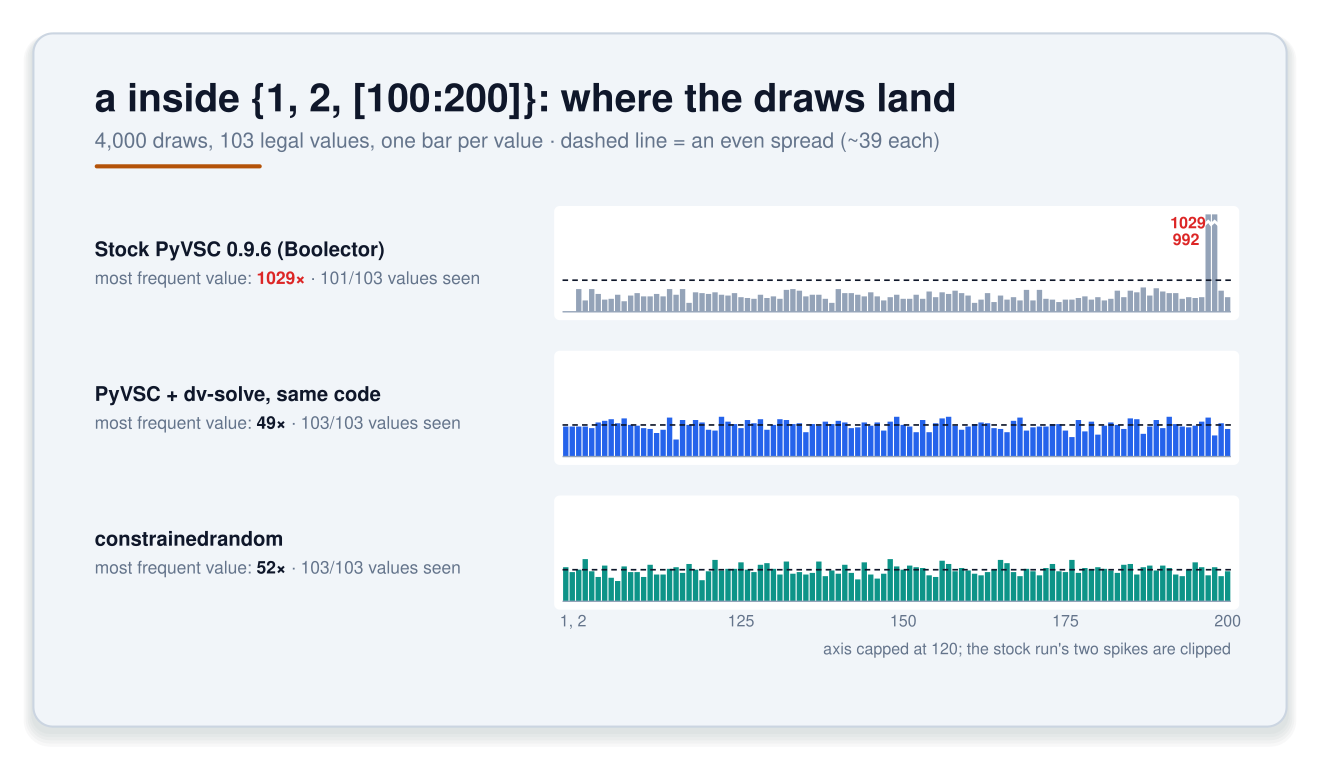
Stock PyVSC put half of its 4,000 draws on just two values, and never drew 1 or 2 at all. The same code on dv-solve spreads the draws as evenly as constrainedrandom does.
The second check is SyoSil’s, which is the best uniformity test I know of in
the published literature: x <= y with both in [0:9], 10,000 draws, and a
count of how often each of the 55 legal pairs comes up. A cell counts as even
if it’s within 10% of the ideal share.
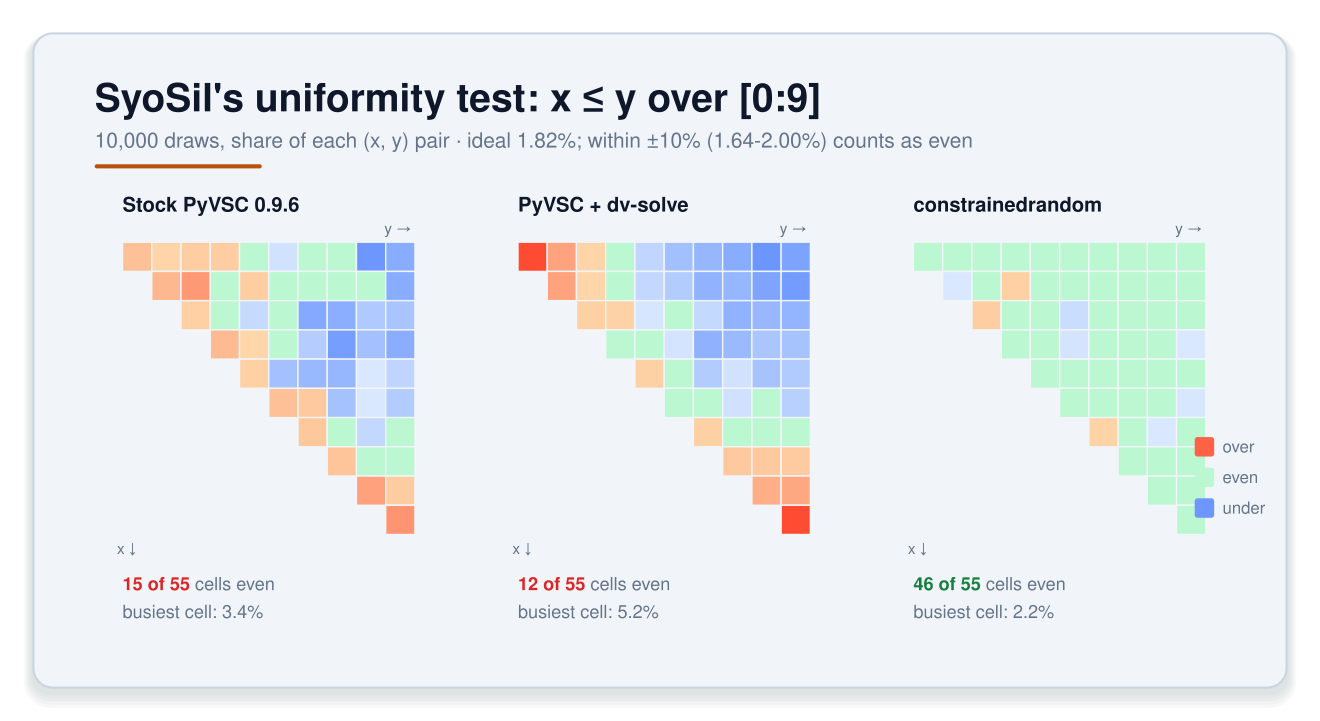
Here dv-solve is no better than stock PyVSC. It’s arguably a little worse, with the two corners of the triangle drawn nearly three times as often as they should be. constrainedrandom passes comfortably. I’d rather show you this than leave it out. Relational constraints between fields are the next thing we’re fixing in the sampler, and this grid is going into the test suite as a gate.
Back to the scoreboard
So how did we do against SyoSil’s summary?
- Complex constraints: kept, and faster.
- Simple constraints: much closer, but not won. constrainedrandom is still
faster on loosely constrained problems and on weighted
dist. On our broader benchmark set with warm caches, the new stack runs at about half constrainedrandom’s speed. - Distribution: fixed for set membership like
inside, not yet for relational constraints likex <= yora < b. constrainedrandom is still closer to uniform there.
So we’re not claiming to be the fastest Python constrained-random library, and we’re not claiming uniform distributions. We’re also not making any comparison with the solvers in commercial simulators. What we are claiming is a big, measured step on every axis users raised – even if there are still gaps.
Closing
Every engineering decision is a trade-off, and we make the best ones when the trade-offs are measured and out in the open. That’s why the misses are in this post alongside the wins.
If you use PyVSC, I’d like your workloads, your constraint shapes and your benchmarks, especially the ones where PyVSC is slow or the distribution looks wrong today. Distribution bugs are invisible unless someone goes looking, and the shapes you care about are the ones we should be testing. The next post explains how to turn on the solver’s cross-checking for your own workloads; please send us anything it flags.
The critiques that shaped this work were public and reproducible, and that’s what made them useful. constrainedrandom’s benchmark suite made our solver better. Better shared benchmarks help every Python verification library, not just PyVSC. The DatagenDV authors put it well:
“Open-source verification tools like PyVSC are still new and need additional vetting. We encourage readers to contribute to open source design verification libraries.”
Next time: the solver.
References
- PyVSC on GitHub and documentation
- PyVSC: WOSET 2020
- constrainedrandom (docs, ORConf 2025 talk)
- SyoSil: An implementation of a Python-based verification environment using PyUVM and cocotb
- Incore / Coverify: Crafting a Million Instructions/Sec RISCV-DV (DVCon)
- Microsoft: DatagenDV: Python Constrained Random Test Stimulus Framework (DVCon)
- Minigutti: Open-Source Verification of digital ASIC/FPGA circuits (FSiC)
- arXiv 2407.10317, arXiv 2503.11666