Open Source PSS: Formatting
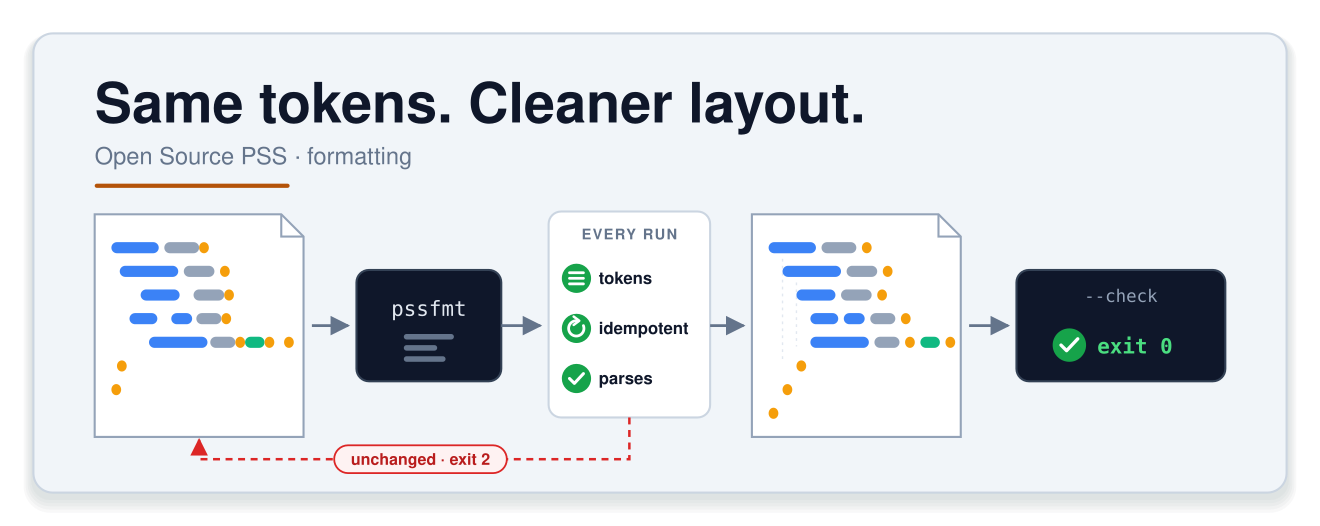
It’s no surprise that well-formatted text is easier to read, and that’s as true of code as it is of prose. But keeping code well formatted by hand is tedious, and it costs more than it would seems. Whitespace diffs obscures legitimate changes, and review comments about whitespace cost everyone time.
Most languages settled this long ago with a formatter: gofmt, Black,
clang-format, Verible. A tool lays the code out the same way every time, and
a CI job checks that it’s been done, so nobody has to think about it. Now PSS
has one too. pssfmt is open source
(Apache-2.0), targets PSS 3.1, and installs with pip install pssfmt.
In my experience, people don’t hesitate to adopt a formatter because of its style. They hesitate because they’re afraid it will break their code. So, if anything, the theme running through this post is the work pssfmt does to ensure that it only changes how your code looks, and never how it works.
pssfmt in 30 seconds
Here’s a small DMA model, written in a hurry:
package dma_pkg{

  buffer data_b{
    rand bit[32]  size;
    constraint size in [64..4096];
  };


  component dma_c {
    action mem2mem_a{
      input data_b   src;
      output  data_b dst;
      rand bit[64] src_addr,dst_addr;
      constraint c_align{
        src_addr%4==0;
        dst_addr % 4 == 0;
      }
    }
    function bit[64] chan_base( int index ){ return DMA_CH_BASE+index*DMA_CH_STRIDE; }
  }
}With no configuration at all, here’s what pssfmt makes of it:
% pssfmt -q messy.pss
package dma_pkg {

    buffer data_b {
        rand bit[32]  size;
        constraint size in [64..4096];
    }

    component dma_c {
        action mem2mem_a {
            input data_b src;
            output data_b dst;
            rand bit[64] src_addr, dst_addr;
            constraint c_align {
                src_addr % 4 == 0;
                dst_addr % 4 == 0;
            }
        }
        function bit[64] chan_base(int index) {
            return DMA_CH_BASE + index * DMA_CH_STRIDE;
        }
    }
}
Braces sit on the line that opens the construct, the indent is four spaces,
operators and commas are spaced, the double blank line is gone, and the
one-line function body is opened out. The meaningless ; after the buffer’s
closing brace is dropped too. We’ll come back to that one.
Notice what didn’t change: rand bit[32] size; keeps its two spaces.
That’s deliberate, and we’ll come back to it as well.
There are four ways to run it:
pssfmt FILEwrites the formatted file to stdout.pssfmt -i FILErewrites the file in place.pssfmt --diff FILEshows what would change, and exits 0.pssfmt --check FILEwrites nothing, and exits 1 if anything would change.
--diff is what a reviewer wants to see. On a whole file that’s never been
formatted, nearly every line changes, so the diff is mostly noise. Its real
use is on code that’s already tidy, where it points straight at the one line
that isn’t:
% pssfmt --diff review.pss
1 file would be reformatted
--- review.pss	original
+++ review.pss	formatted
@@ -4,7 +4,7 @@
         rand bit[32] size;
         constraint c_align {
             src_addr % 4 == 0;
-            dst_addr%4==0;
+            dst_addr % 4 == 0;
         }
         constraint c_size {
             size in [64..4096];
Source: review.pss (raw)
--check is what CI runs.
Not just declarations
pssfmt 0.3.0 also lays out procedural code: if/else chains, loops, and
long parameter lists. Here’s an else chain written three different ways:
function bit[32] words(bit[32] n, bit[8] width, bool packed) {
    if(packed){
        n = (n + width-1)/width;
    }
    else if (width==8) {
        n = n>>2;
    }
    else
    {
        n = n*2;
    }
    return n;
}
pssfmt gives it one shape:
% pssfmt -q else.pss
function bit[32] words(bit[32] n, bit[8] width, bool packed) {
    if (packed) {
        n = (n + width - 1) / width;
    } else if (width == 8) {
        n = n >> 2;
    } else {
        n = n * 2;
    }
    return n;
}The chain comes out as } else if (…) { and stays flat, rather than nesting
one level deeper per branch.
Line breaks follow the content, too. Here the first prototype is 94 columns wide, and the second function has its whole body on one line:
component dma_c {
    function bit[32] desc_words(bit[32] nbytes, bit[8] width, bool packed, bit[32] base_addr);
    function bit[32] chan_base(int index) { return DMA_CH_BASE + index * DMA_CH_STRIDE; }
}
% pssfmt -q params.pss
component dma_c {
function bit[32] desc_words(
bit[32] nbytes,
bit[8] width,
bool packed,
bit[32] base_addr
);
function bit[32] chan_base(int index) {
return DMA_CH_BASE + index * DMA_CH_STRIDE;
}
}Source: params.pss (raw)
The parameter list is broken one item per line because it doesn’t fit in 80 columns, not because of where the author happened to press Enter. Break the list by hand in odd places and pssfmt produces exactly the same output.
It won’t break your code
Back to the fear. What should a formatter promise? pssfmt makes three promises, and it checks them on every run:
- The tokens don’t change. Every non-whitespace token in the output is identical, in type and text, to the one in the input, and every comment is kept exactly.
- Formatting is idempotent. Formatting the output again changes nothing:
fmt(fmt(x)) == fmt(x). - No new parse errors. The output has no parse errors that the input didn’t already have.
The important word is every. These aren’t checks in pssfmt’s test suite; they run each time you format a file. If any check fails, your file is left exactly as it was, and pssfmt tells you so. That fail-safe is the default path, not a flag you have to remember to pass.
One consequence is worth calling out if you’ve been burned by other
formatters: the parentheses you wrote are always kept, and pssfmt never adds
any. It works on a concrete syntax tree, where ( is a token like any
other, instead of rebuilding your code from an abstract syntax tree plus a
precedence table.
Idempotence is easy to check for yourself:
% pssfmt -q messy.pss > once.pss
% pssfmt -q once.pss  > twice.pss
% diff once.pss twice.pss ; echo "exit=$?"
exit=0
It’s more convincing at scale. The pssfmt project measures itself against pss-corpus, a shared collection of real PSS. Formatting each of its 92 curated files, then formatting the result again and comparing bytes, gives:
byte-identical=36 reformatted=56 non-idempotent=0 declined=0 total=92The numbers that matter are the zeros: no file failed to converge, and no file was declined.
What a caught bug looks like
Safety checks are easy to describe and hard to believe until you see one fire. So here’s a real one. pssfmt 0.1.0, the first release on PyPI, had a bug: a comment on the same line as an opening brace was lost during layout.
% pssfmt brace.pss          # pssfmt 0.1.0
brace.pss: left unchanged -- the formatted output failed verification:
  comments: comment 1 changed: '// DMA engine model' -> <end of file> (input has 1 comment, output 0)
  This is a pssfmt bug. The file has not been modified.
1 file declined
package dma_pkg { // DMA engine model
  component dma_c{
    action xfer_a { rand bit[32] len; }
  }
}
exit=2The comment check caught the bug every time it happened, so the bug never
damaged a file. Read the diagnostic as three facts: which check failed
(comments), what it saw (one comment in, none out), and what happened to
your file (nothing). The original was written back out unchanged. And the
last line sums up the whole attitude: “This is a pssfmt bug. The file has
not been modified.”
Version 0.3.0 fixes the bug:
% pssfmt brace.pss          # pssfmt 0.3.0
1 file would be reformatted
package dma_pkg { // DMA engine model
    component dma_c {
        action xfer_a {
            rand bit[32] len;
        }
    }
}
Note the exit code on the declined file: 2, not 1. A 1 from --check
means “the answer is no: this file needs formatting.” A 2 means “I couldn’t
compute the answer.” From the outside, a declined file looks exactly like a
clean one, with no diff and nothing written. Without the explicit message and
the distinct exit code, a formatter bug would show up as a file that
mysteriously never gets formatted.
A familiar style, checked against real code
The second thing people argue about is the style itself. Every formatter has
to answer questions like “Where does the brace go?” and “Is it a*b or
a * b?” pssfmt doesn’t invent new answers. It follows the conventions most
PSS users already write in C, C++, and SystemVerilog, and that established
formatters like clang-format, gofmt, and Black have settled on:
- four-space indents, and never tabs
- K&R braces:
{on the line that opens the construct, and} else {cuddled - one space around binary operators:
index * STRIDE - at most one blank line in a row, and no trailing whitespace
- an 80-column line width
What PSS does have is a way to check those conventions against real code. The pssfmt repository includes a survey tool that reads pss-corpus token by token and counts how its authors actually write. It groups the code by voice rather than by file: today that’s one organization’s hand-written PSS, the PSS core library from an unrelated project, and a register-model generator. That grouping matters because agreement across independent authors is evidence. The same habit repeated in 48 files by one author is one opinion counted 48 times.
Even with a small corpus, the check already confirms several of the rules. Braces go on the opening line in 732 of 733 cases, and not one indented line uses a tab. The line width is the most striking. Here are line lengths for the two human voices:
    76  #####################################  105
    77  ##################################       98
    78  ###################################     100
    79  ###################################     101
    80  ###########################              78
    81  ######                                   19   <-- cliff
    82  #                                         3
That isn’t an average sitting below 80. It’s a wall: PSS authors already wrap to 80 columns, so the convention and the code agree.
The check is also useful when it pushes back. Most formatters, gofmt,
rustfmt, and Black among them, strip blank lines after an opening {. pssfmt
did too, until the survey showed the two human voices writing those blank
lines in 41 of the corpus’s 92 files. The rule was backed out. The convention
was a good starting point, and the corpus showed where PSS code differs.
Where the corpus is silent, convention decides. There are only five
if/else statements in the corpus, and they don’t agree, so } else {
follows K&R, the Linux kernel, Google’s C++ style, and lowRISC. Spacing
around * is similar: the hand-written voice writes index * STRIDE, the
generator writes index*STRIDE, and pssfmt takes the C convention.
The style guide records,
rule by rule, what the corpus currently says, and tools/style_survey.py
regenerates every figure. Today some of those figures are thin. The mechanism
is the part that lasts: every new voice added to pss-corpus makes the check
stronger, and turns “I don’t like it” into a conversation about what PSS code
actually looks like.
Where it won’t have an opinion
The most surprising thing about a good formatter is what it leaves alone.
Remember rand bit[32] size; from the first example? pssfmt’s alignment
setting defaults to infer. A block whose columns the author lined up is
kept, and a block that only sort of lines up is set flush:
% pssfmt -q align.pss
component regs_c {
    // an author-built table: three lines, columns already lined up
    bit[8]   cmd;      // command register
    bit[16]  addr;     // destination address
    bit[8]   status;   // completion status

    // a ragged block: nobody built a column here
    bit[32] ctrl;
    bit[8] mode;
    bit[16] irq_mask;
}One file, two blocks, opposite results, and no configuration.
Target templates are another place pssfmt keeps its hands off. The text inside
exec body C = """…""" is C, not PSS, so it’s copied byte for byte. Below,
cat -A makes the whitespace visible: the tab (^I), the odd indent, and the
trailing spaces inside the template all survive, while the PSS around them
moves.
% pssfmt -q exec.pss | cat -A
component dma_c {$
    action start_a {$
        exec body C = """$
^Idma_program_chunk( 0 );$
            dma_start();   $
""";$
    }$
}$pssfmt makes three standing commitments:
- It never reorders anything.
- It never reflows comment text.
- It never touches the inside of a target template.
There’s exactly one option that changes your tokens: optional_semicolon,
which controls the ; that PSS allows, but doesn’t need, after a closing
brace. The default, omit, drops it, as in the first example. preserve
leaves yours alone, and require adds one everywhere it’s legal. When this
option is active, the token check is relaxed to allow exactly that one
difference, in that one direction, and nothing else.
The off switch
Some content shouldn’t be automatically indented: for example, a hand-aligned register table. pssfmt gives you three levels of control:
// pssfmt off…// pssfmt onprotects a region.// pssfmt ignoreprotects the next construct.- A
.pssfmtignorefile (gitignore syntax) excludes paths, such as agen/directory of generated code.
A protected region is copied, not merely exempted. Tabs, trailing whitespace, and blank lines are all kept. The only change is that the region’s first line takes the indent of the code around it:
% pssfmt -q hatch.pss | cat -A
component spi_c {$
    // pssfmt off$
    struct^Ispi_csr_s {$
^I    bit[8]  cmd;^Ibit[16] addr;$
^I    bit[8]  status;^Ibit[16] mask;$
^I}$
    // pssfmt on$
$
    action xfer_a {$
        rand bit[16]  len;$
    }$
}$The struct line moved, and nothing under it did.
This matters more in 0.3.0 than it did before. Long parameter lists are now
joined and re-broken from their content, so a parameter list you aligned
into columns by hand loses those columns. Three of the five in the corpus
did. // pssfmt off is how you keep one.
Two smaller details:
.pssfmtignorefilters a directory search, never a file you name.pssfmt -i gen/x.pssformats that file, because you typed its name.--lines A:Bformats only the given lines of a file. On a codebase that’s never been formatted, this lets you format just what you touched, so the first review stays about your change instead of the whitespace.
Putting it in CI
The CI integration is --check plus an exit code:
| Situation | Exit |
|---|---|
| Already formatted, or formatted successfully | 0 |
--check: at least one file would change |
1 |
| Unreadable file, bad configuration, bad usage, or a declined file | 2 |
A gate that treats every non-zero code the same will eventually report a
broken toolchain as a style failure. Check for 1 and 2 separately.
pssfmt runs alongside the parser from the previous post in the same job. pssparser gates on correctness, and pssfmt gates on layout:
- run: pip install pssparser pssfmt==0.3.0
- run: pssparser src/*.pss
- run: pssfmt --check src/
Notice the pinned version. pssfmt always follows the latest defaults. While pssfmt is under activate development, at least, there are likely be new changes every release. If this churn creates issues, consider pinning the release so you only see formatting changes due to code that you modified.
A few details make -i safe to run anywhere:
- Files that are already formatted aren’t rewritten, so their timestamps don’t change and nothing downstream rebuilds.
- Output is written to a temporary file and then renamed into place, so a crash never leaves half a file.
- The file’s encoding and line endings are preserved. A UTF-16 file (the default for Windows PowerShell 5.1) is written back in UTF-16, and CRLF stays CRLF. A formatter that re-encoded files would make changes you’d never see in the diff.
% file u16.pss ; pssfmt -i u16.pss ; file u16.pss
u16.pss: Unicode text, UTF-16, little-endian text
reformatted u16.pss
1 file reformatted
u16.pss: Unicode text, UTF-16, little-endian text
Configuration, briefly
This section is deliberately short because pssfmt is intended to work without
extra configuration. In the rare event that you do need options, they go in a .pssfmt file
or in a [tool.pssfmt] table in pyproject.toml. Both are TOML, and both
are found by searching upward from each file. The first one found wins
outright, with no merging, and the search stops at the top of your
repository, so a stray .pssfmt in your home directory can’t restyle every
checkout.
There are 15 options. They exist for projects that have already decided
something, such as pack_arguments = "bin_pack" for LLVM-style packed
argument lists. What’s worth showing is what happens when you get one wrong:
% cat .pssfmt
indent_widht = 2
% pssfmt --check messy.pss ; echo "exit=$?"
pssfmt: .pssfmt: unknown option `indent_widht`; did you mean `indent_width`?
exit=2
That’s exit 2, and the files under that configuration are skipped rather than formatted with the defaults. Falling back silently would let one typo restyle a whole directory tree.
What it doesn’t do yet
pssfmt’s gaps are quiet rather than dangerous. A construct with no layout rule is reproduced exactly, so an incomplete rule set can’t damage a file. As of 0.3.0, per the project’s status page, these are still reproduced as written:
- Unbraced branches like
if (x) y;. Adding the braces would change your tokens. repeat { … } while (e);, whose block sits in the middle of the statement.- Map and struct literals like
{"a": 1}and{.x = 1}. The corpus contains none. - Inline constraints (
do step with { … }), guarded and weightedselectbranches,matchin activities,replicate, and themonitoroperators. Each appears once, or in only one file, and one author’s habit isn’t a convention. - Allman braces.
brace_style = "break"is recognized but not implemented, and pssfmt says so.
That’s a fair way for the tool to be. A formatter with a rule for every PSS construct on day one would have had to make most of them up.
Conclusions and next steps
pssfmt helps you keep your PSS codebase properly formatted, making it easier to read and keeping code reviews focused on real content – not whitespace. What’s more, its built-in safeguards ensure that it a formatter bug doesn’t accidentally corrupt your source. Consider having a look at the style guide to better-understand the conventions currently used.
A few ways you can help:
- Run
pssfmt --diffon a model you already have. If you disagree with the result, the style guide shows what the corpus says about that rule. Tell us where it’s wrong. - File issues on GitHub, especially for any file pssfmt declines. A declined file is, by definition, a pssfmt bug.
- Contribute PSS to pss-corpus. Every new voice makes the style check more meaningful, and today the corpus is small.
That last ask is the one I’d underline. pss-corpus isn’t pssfmt’s private test set. pssparser and its linter test against it too, and every tool built on it gets better each time someone adds real code. That’s the value of a shared set of open tooling: no single user, vendor, or project has to build it, and everyone who contributes gets something they couldn’t have built alone. As always, your contributions are welcome and appreciated!
Next time, we’ll look at the linter: the same parser, gating on what your code means rather than how it looks.
References
- pssfmt on GitHub (Apache-2.0)
- pssfmt on PyPI
- pssfmt documentation: quickstart, command line, configuration, style, status
- pss-corpus, the corpus the style is checked against
- Example files used in this post: messy.pss, review.pss, else.pss, params.pss, brace.pss, align.pss, exec.pss, hatch.pss
- Open Source PSS: PSSParser