Open Source PSS: Checking Beyond the LRM
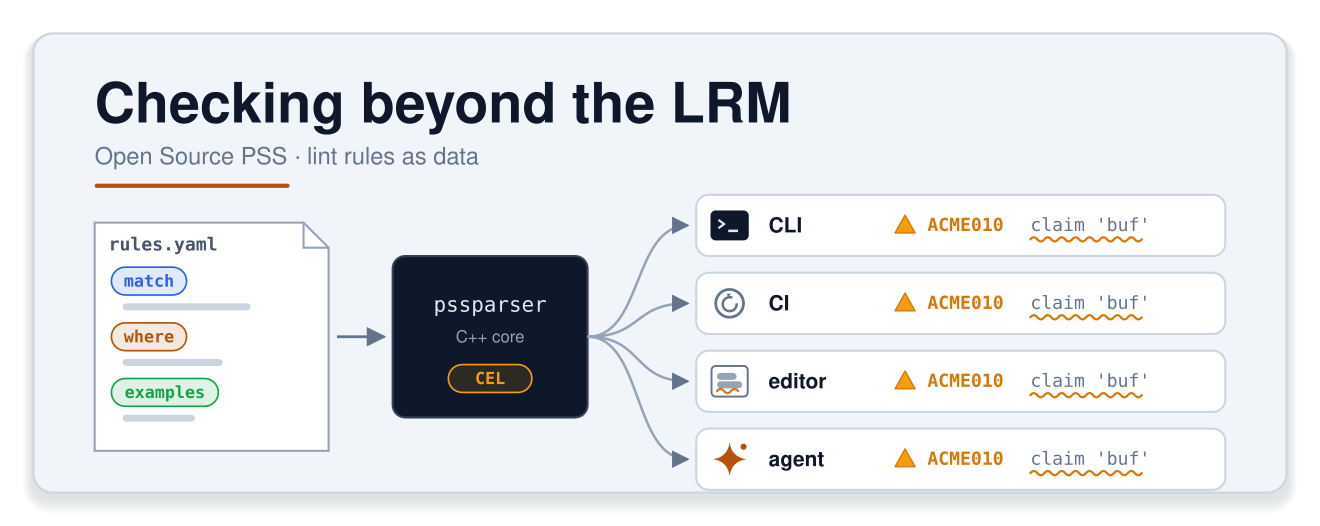
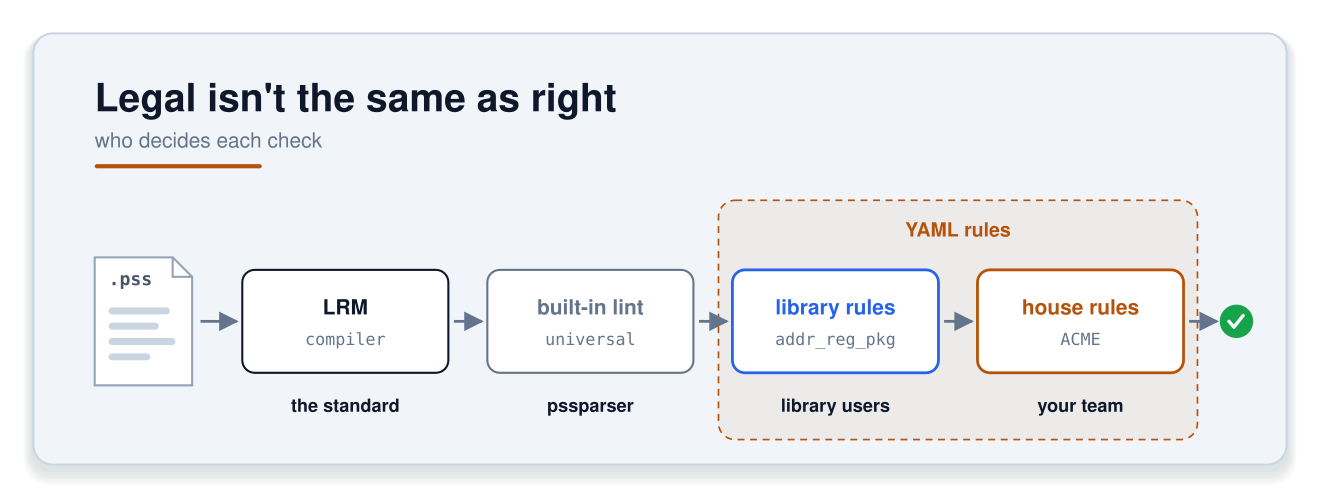
Compilers check whether source code is legal according to the language reference manual (LRM). But legal isn’t the same as right. A model can be perfectly legal PSS and still use a library in a way that can’t work, or ignore conventions that the rest of your team follows. Catching that is the job of a linter.
Some of what a linter checks is universal. Much of it isn’t: it’s specific to a library, a project or a company. In this post, we look at how pssparser lets you write those checks yourself, as a few lines of YAML rather than as a plug-in, and how the same rule then runs on the command line, in CI, in an editor and in the hands of an AI agent.
Checks beyond the language
Let’s start with two things we’d like a tool to catch, neither of which is an LRM violation.
A library used in a way that can’t work. Address claims from the core
library’s addr_reg_pkg describe a block of memory an action needs. The
solver picks the claim’s size, alignment and placement, but only if the
claim is rand. Here’s Example 348 from the
PSS 3.1 public review draft:
action my_action {
    transparent_addr_claim_s<> claim;
    constraint claim.alignment == 2**4;
    exec body {
        int offset = 16;
        int data = 128;
        addr_handle_t h0 = make_handle_from_claim(claim, offset);
        write32(h0, data);
        // ...
    }
};
Every other claim in that chapter is declared rand. This one isn’t, so it
isn’t randomized: its size, alignment and trait keep their default values,
and the constraint on alignment becomes a check on a fixed value rather
than a request to the solver. The model is legal, and the mistake is easy to
make (it made it into the standard’s own examples). Catching it up front
saves a confusing solve failure or a test that quietly does less than you
think. A check like this also needs an escape hatch: if you really do mean a
fixed claim, you need a way to say so.
A house convention. Many teams name types by kind: actions end in _a,
components in _c, structs in _s. Nothing in the LRM cares. But if that’s
your team’s style, you want a tool to enforce it, rather than leave it to
code review, and you want an AI agent writing PSS for you to follow it too.
Another team will have a different convention, or none at all.
The first check is about a library that everyone shares. The second is about one team’s preferences. Neither belongs in the compiler, and the second doesn’t really belong encoded in a fixed tool. So the real question is how easy it is to add checks like these yourself.
Why not plug-ins?
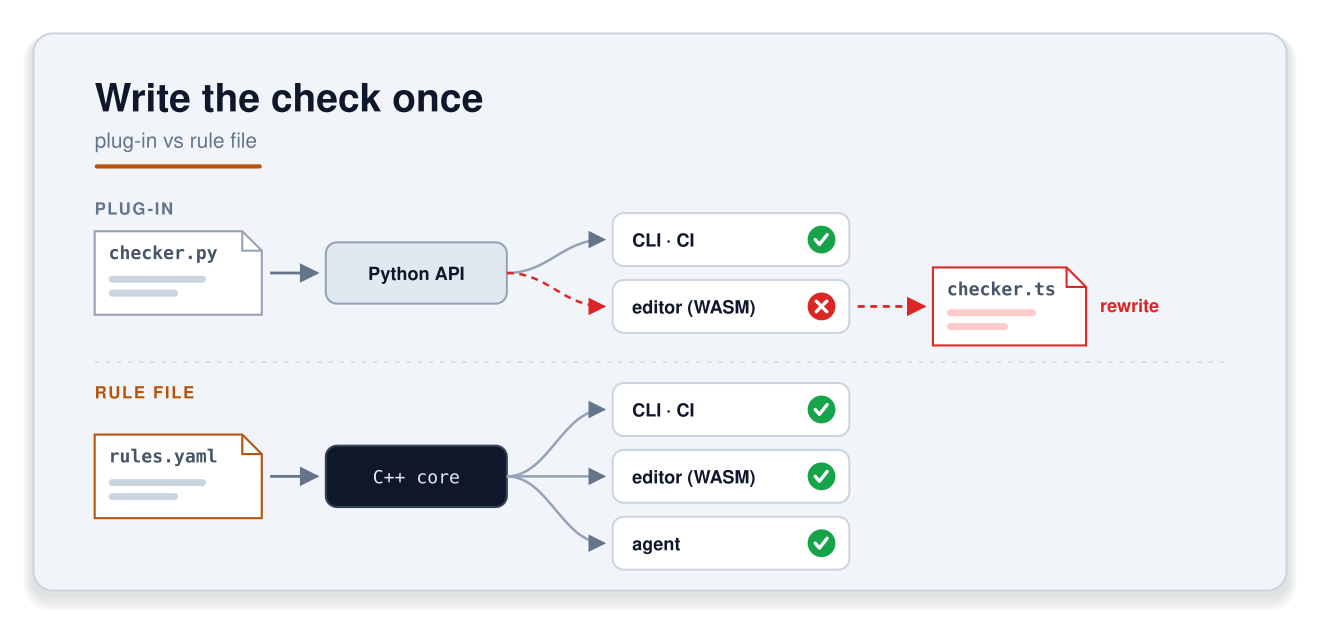
Most lint tools answer that question with plug-ins: write code against the tool’s API, package it, install it. pssparser has that too: a Python checker API. But plug-ins have costs that keep custom checks rarer than, perhaps, they could be:
- You write code against the tool’s internals. Even a one-line naming rule means learning an AST API, a registration mechanism and a packaging story.
- They’re tied to one implementation language. A Python plug-in runs where Python runs. pssparser also runs inside an editor’s language server, through a WebAssembly (WASM) build of its C++ core under Node. A Python plug-in can’t run there, so the check would have to be written a second time, in TypeScript, and the two copies kept in step.
- They’re awkward to distribute. A team’s style rules should live in the team’s repository, next to the code they apply to, not in a package everyone has to install.
Rules as data
So we’re taking a different approach, borrowed from tools that have solved
the same problem elsewhere. ESLint’s
no-restricted-syntax,
ast-grep and
Semgrep all let users
write rules as data: a pattern that selects syntax-tree nodes, and a
condition. Kubernetes’
ValidatingAdmissionPolicy
and protovalidate write their
conditions in CEL, the Common Expression Language: a
small expression language that can’t loop forever and is cheap to evaluate.
A pssparser rule follows the same pattern:
- A rule lives in a YAML file, with as many rules as you like per file.
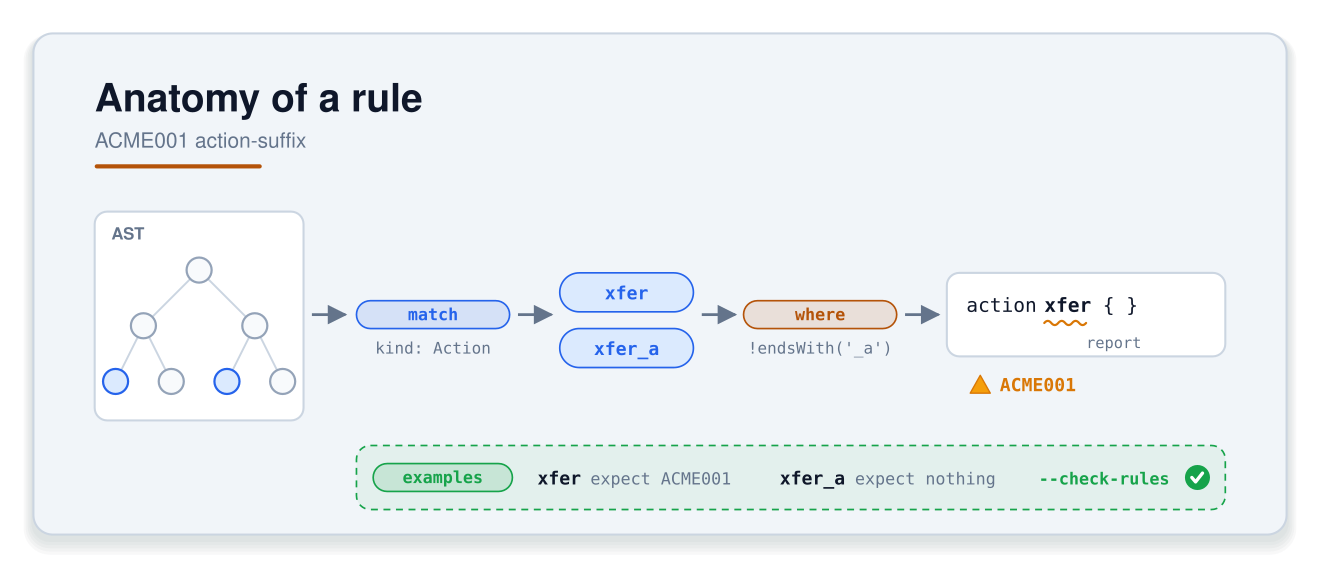
match:picks the AST nodes the rule looks at, by kind (Action,Field, …) and, optionally, by what they’re inside.where:is a CEL expression over the node, which can call a library of functions that ask the linked model questions: what a reference resolves to, where a declaration is used, what a constant evaluates to.examples:are small models marked with the findings they should produce. They’re the rule’s tests, and its documentation.
The rule files are interpreted by pssparser’s C++ core, not by Python. That core is the same one the Python CLI uses and the one compiled to WASM for Node, so a rule file runs unchanged on the command line, in CI and in an editor.
What a rule looks like
Here’s the action naming rule:
# house_naming.yaml -- ACME house naming conventions
pss-rules:
  defaults:
    family: naming
    tier: style
    severity: warning

  rules:
    - id: ACME001
      name: action-suffix
      summary: Action type names end in '_a'.
      message: "action '${node.name.id}' should end in '_a'"
      match: { kind: Action }
      where: "!node.name.id.endsWith('_a')"
      report: "[node.name]"
      examples:
        - code: |
            component pss_top {
              action xfer { }      // expect: ACME001
              action xfer_a { }
            }
Source: house_naming.yaml (raw)
Taking it a field at a time:
idandname.ACME001andaction-suffixboth name the rule anywhere pssparser takes one: on the command line, in configuration, in waivers. TheACMEprefix is your namespace; pssparser reserves only its own (PSS,PSSP,LINT).match. The rule looks at everyActiondeclaration.where. It fires when the name doesn’t end in_a.node.nameis an identifier node;.idis its text.message.${...}pulls values from the model into the message.report. Report at the action’s name rather than across its whole body.examples.xfermust be reported, andxfer_amust not.defaults. Thefamily,tierandseverityapply to every rule in the file. Astylerule normally reports a hint, which only an editor shows; this file asks for a warning instead.
The file has two more rules just like it: components end in _c (with
pss_top exempt) and structs end in _s.
Turning rules on
Rule files are named in the project’s configuration: the .pssparser.toml
file (or [tool.pssparser] table in pyproject.toml) that holds the rest
of pssparser’s settings. A rule from a file runs once it’s selected:
# .pssparser.toml
version = 1

[lint]
rules = ["house_naming.yaml", "memory_claims.yaml"]
select = ["ACME"]
Source: house_rules.toml (raw) – save it as .pssparser.toml
rules takes files or directories (every rule file directly in a
directory is loaded), relative to the configuration file. --rules PATH on
the command line adds more. select = ["ACME"] turns on every rule in the
ACME namespace.
Here’s a small DMA model with a few problems:
import addr_reg_pkg::*;

struct dma_desc {
    rand bit[32] src;
    rand bit[32] dst;
    rand bit[16] len;
}

component dma_engine {
    action xfer_a {
        rand dma_desc               desc;
        transparent_addr_claim_s<>  buf;
        constraint buf.size == desc.len;
    }
}

component pss_top {
    transparent_addr_space_c<> sys_mem;
    dma_engine                 dma;
}
Source: dma_house.pss (raw)
% pssparser dma_house.pss
dma_house.pss:3:8: warning: [ACME003] struct 'dma_desc' should end in '_s'
 3 | struct dma_desc {
   |        ^~~~~~~~

dma_house.pss:9:11: warning: [ACME002] component 'dma_engine' should end in '_c'
 9 | component dma_engine {
   |           ^~~~~~~~~~

dma_house.pss:12:37: warning: [ACME010] claim 'buf' is not 'rand', so it is not randomized: its size, alignment and trait keep their default values
 12 |         transparent_addr_claim_s<>  buf;
    |                                     ^~~

3 warnings in 1 file
Your rules are first-class rules
Once loaded, a rule from a file is a rule like any built-in one. It’s in the catalogue:
% pssparser --list-markers | grep -E '^ID|ACME'
ID       SEV       CHECKER    SUMMARY
ACME001  warning   pss-rules  Action type names end in '_a'.
ACME002  warning   pss-rules  Component type names end in '_c'.
ACME003  warning   pss-rules  Struct type names end in '_s'.
ACME010  warning   pss-rules  An address claim is not declared 'rand'.
--explain documents it, including where it’s defined and its first
example:
% pssparser --explain ACME001
ACME001 action-suffix
Action type names end in '_a'.

  tier:              style
  family:            naming
  analysis level:    L0
  scope:             file
  matches:           Action
  defined in:        house_naming.yaml:9:7
  default severity:  warning
  fix:               none available

Flagged (example 1):

    component pss_top {
      action xfer { }
      action xfer_a { }
    }
The warning policy applies to it. Here the naming family fails the build, and the claim check stays a warning:
% pssparser -Werror=family:naming dma_house.pss
dma_house.pss:3:8: error: [ACME003] struct 'dma_desc' should end in '_s' [-Werror=family:naming]
 3 | struct dma_desc {
   |        ^~~~~~~~

dma_house.pss:9:11: error: [ACME002] component 'dma_engine' should end in '_c' [-Werror=family:naming]
 9 | component dma_engine {
   |           ^~~~~~~~~~

dma_house.pss:12:37: warning: [ACME010] claim 'buf' is not 'rand', so it is not randomized: its size, alignment and trait keep their default values
 12 |         transparent_addr_claim_s<>  buf;
    |                                     ^~~

2 errors, 1 warning in 1 file
% echo $?
1
And it can be waived in the source, with a reason, when the convention doesn’t fit:
// pssparser waive ACME002: name fixed by the IP-XACT import
component dma_engine {
% pssparser waived.pss
waived.pss:3:8: warning: [ACME003] struct 'dma_desc' should end in '_s'
...
waived.pss:13:37: warning: [ACME010] claim 'buf' is not 'rand', so it is not randomized: its size, alignment and trait keep their default values
...
2 warnings in 1 file (1 waived)A rule that knows the library
The naming rules only look at names. The claim rule has to know about types: it needs to ask “is this field’s type a claim?”, including when the type is a user’s subtype of a claim several levels down. That takes the linked model, not just the syntax tree:
# memory_claims.yaml
pss-rules:
  rules:
    - id: ACME010
      name: claim-not-rand
      tier: suspicious
      family: decl
      summary: An address claim is not declared 'rand'.
      message: >-
        claim '${node.name.id}' is not 'rand', so it is not randomized:
        its size, alignment and trait keep their default values
      match: { kind: Field, inside: { kind: Action } }
      let:
        t: type_decl(node.type)
      where: >-
        !has_flag(node.attr, FieldAttr.Rand) && t.hasValue()
        && derives_from(t.value(), "addr_reg_pkg::addr_claim_base_s")
      examples:
        - code: |
            import addr_reg_pkg::*;
            component pss_top {
              transparent_addr_space_c<> mem;
              action my_action {
                transparent_addr_claim_s<> claim;       // expect: ACME010
                rand transparent_addr_claim_s<> ok;
              }
            }
Source: memory_claims.yaml (raw)
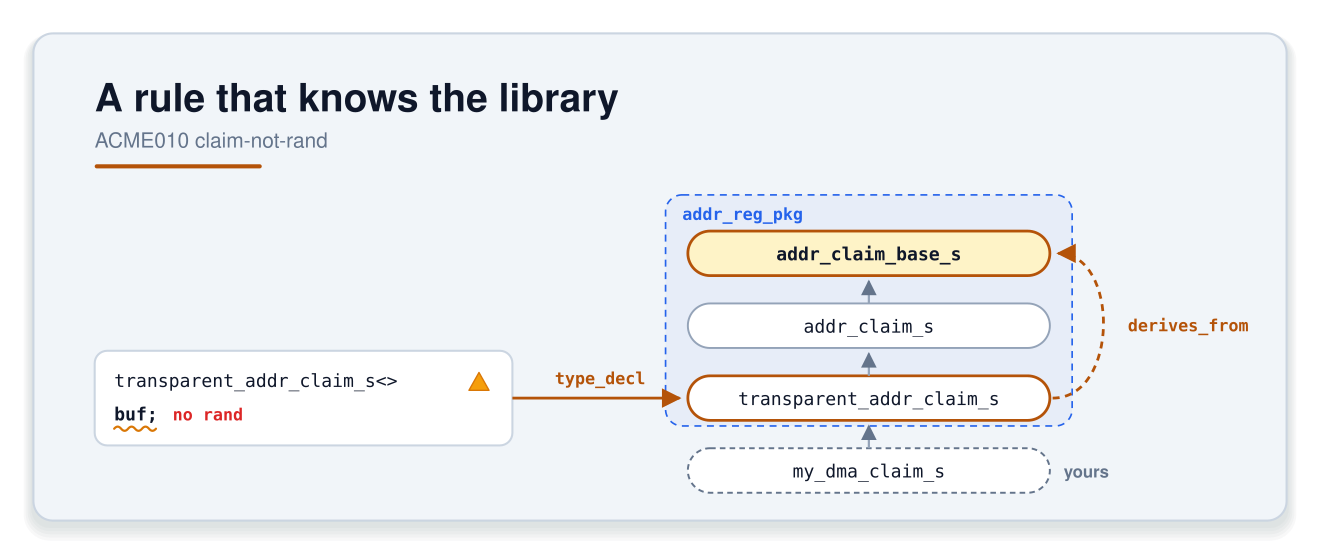
type_decl follows the field’s type (through typedefs and template
specializations) to its declaration, and derives_from walks its base
types. Because the base type is named as a path into the core library, the
rule catches transparent_addr_claim_s, addr_claim_s and any subtype of
them that you define yourself. The let: entry names an intermediate value
so that where: stays readable.
This is the kind of rule that’s worth sharing beyond one team. Anyone who
uses addr_reg_pkg can make this mistake, so a rule written once can be
used by every PSS user.
The same rules in the editor
Since the rules run in the C++ core, the WASM build used by editor tooling runs them too. Here are the same two rule files, and the same model, run from Node:
import { readFileSync } from 'node:fs';
import { createParser } from '@psstools/pssparser';

const read = (f) => readFileSync(f, 'utf8');
const parser = await createParser();
parser.parseSources([{ name: 'dma_house.pss', content: read('dma_house.pss') }]);
parser.link();
parser.loadRules([
  { name: 'house_naming.yaml',  text: read('house_naming.yaml') },
  { name: 'memory_claims.yaml', text: read('memory_claims.yaml') },
]);
for (const m of parser.runLint().markers)
  console.log(`${m.file}:${m.line}:${m.col}: ${m.severity}: [${m.code}] ${m.message}`);
Source: lint_in_node.mjs (raw)
% node lint_in_node.mjs
dma_house.pss:3:8: warning: [ACME003] struct 'dma_desc' should end in '_s'
dma_house.pss:9:11: warning: [ACME002] component 'dma_engine' should end in '_c'
dma_house.pss:12:37: warning: [ACME010] claim 'buf' is not 'rand', so it is not randomized: its size, alignment and trait keep their default values
The same findings, at the same positions, from the same rule files. Hooking this into the PSS language server, so rules show up as you type, is the next step.
Writing rules with an agent
Our naming rule is the kind of thing a team decides in a meeting and then never quite gets around to enforcing. Writing the rule is now short work, and it’s work an AI agent does well, because the format gives the agent something it can check.
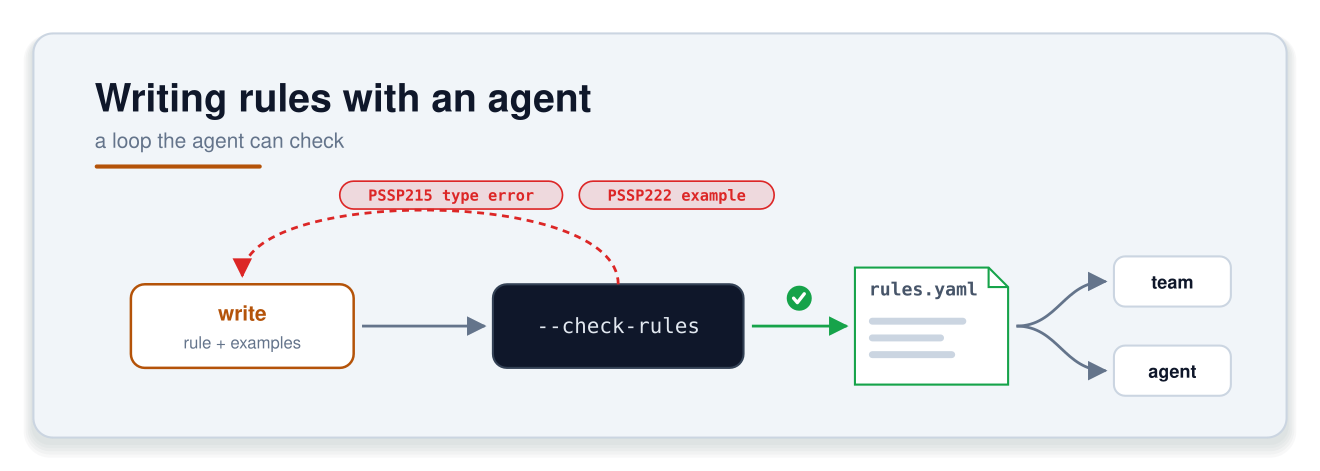
The loop goes like this: write the rule and its examples, run
pssparser --check-rules, fix what it reports, and repeat. Two things make
that loop tight. First, expressions are type-checked when the file loads,
and the errors say what to write instead. Here, the rule used the
identifier node where it needed the text:
% pssparser --check-rules typo.yaml
typo.yaml:14:16: error: [PSSP215] no matching overload for 'endsWith' applied to (ExprId, string) (the first is the receiver); it takes string.endsWith(string) -> bool
 14 |       where: "!node.name.endsWith('_a')"
    |                ^
Second, the examples are run as tests. Drop the ! from the action rule,
and both of its examples fail:
% pssparser --check-rules action_rule.yaml
action_rule.yaml:17:11: error: [PSSP222] example 'example 1' of ACME001: expected ACME001 at line 2, but it was not reported
 17 |         - code: |
    |           ^

action_rule.yaml:17:11: error: [PSSP222] example 'example 1' of ACME001: ACME001 was reported at 3:10, which the example does not expect
 17 |         - code: |
    |           ^

2 errors in 1 file
pssparser ships agent skills that describe how to use it. We’re adding one that teaches rule writing: the file format, the function library, and this loop. With it, a request like this becomes a reviewed, tested rule file:
Our house style is that action types end in
_a, components in_c(exceptpss_top) and structs in_s. Write pssparser rules for it, with examples, and check them.
The same rule files then tell the agent what your house style is: point it
at them, or let it run pssparser on what it writes, and it gets the same
findings you’d get in review.
What we have, what we don’t, and how you can help
What’s here today is a framework. The rule format, the CEL engine, the example-driven tests and the configuration all work, on the command line and in WASM. What’s thin is the set of rules: pssparser’s own checks are still the handful of warnings from the last post, and the library of functions that rules can call is growing as we write rules that need them.
That’s where we’d like your help:
- Try the format. Write a rule for a convention your team follows, and tell us where the format got in the way.
- Share rules for shared libraries. A rule about
addr_reg_pkgorstd_pkgusage helps everyone who uses them. Those can become built-in rules. - Report the gaps. If a rule you want can’t be written because a function is missing, that’s exactly the input we need.
Issues and pull requests are welcome on GitHub. PSS is a young language with a small community, and every check we write once, in the open, is one that no team has to rediscover or rewrite for its own flow. The more of that knowledge lives in shared tools, the easier PSS gets for everyone.
References
- pssparser on GitHub
- pssparser documentation
- Example files used in this post: dma_house.pss, house_naming.yaml, memory_claims.yaml, house_rules.toml, lint_in_node.mjs
- CEL, the Common Expression Language
- ast-grep rule reference, Semgrep rule syntax, ESLint no-restricted-syntax
- PSS 3.1 Draft
- Open Source PSS: PSSParser