PSS 3.1: Simplifying Composition
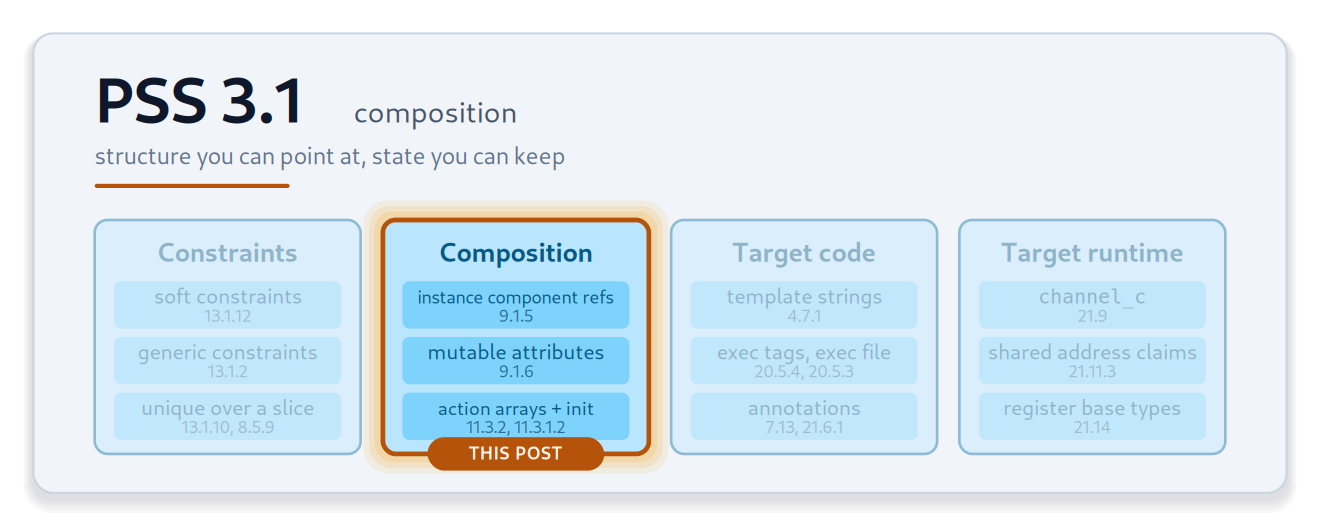
A PSS description is structure, in much the same way that hardware is structural. Even PSS activities are visualized as UML diagrams – which have a certain structure to them. The next category of features to look at in PSS 3.1 are features that help to simplify the structural aspect of PSS models. These range from incremental improvements to fairly significant changes in capability. And it’s the significant ones that are worth the most careful reading during public review, because they change what a reusable PSS model can look like.
Action Initialization
PSS activities use constraints heavily. While constraints are great
for expressing rules to guide the scenario solver, sometimes we just
want to hand a sub-action a value that was never in question. Before 3.1
there was exactly one channel from an activity into a sub-action – an
in-line with constraint – and it only reaches rand fields. So passing
data meant expressing it as a constraint whether or not it was a
choice, and that has a consequence beyond verbosity: constraints
operate on numbers, so anything you pass this way has to be reduced to an
address.
That’s the real cost, and it shows up in reuse. Consider an action that claims
a large block of memory and divides it up between several sub-actions. Here’s
the pre-3.1 shape. scatter_a claims one contiguous block per direction with
transparent_addr_claim_s, and then has to get a quarter of each block into
each xfer_a.
action xfer_a {
    rand bit[64]          src, dst;   // plain addresses, no handle
    rand int in [1..4096] sz;
}

action scatter_a {
    rand addr_claim_s<> src_claim, dst_claim;

    constraint src_claim.size == 4*4096;
    constraint dst_claim.size == 4*4096;

    xfer_a x[4];

    activity {
        foreach (x[i]) {
            x[i] with {
                src == src_claim.addr + i*4096;
                dst == dst_claim.addr + i*4096;
                sz  <= 4096;
            };
        }
    }
}
That works, and it costs more than it looks like. The eight extra solver
variables are the visible price; the structural one is that src_claim.addr
appears in an arithmetic expression at all. .addr only exists on
transparent_addr_claim_s, so the claims are forced to be transparent –
the moment you need to subdivide a block by constraint, you’ve committed the
model to an address space whose absolute addresses are known at solve time.
Point scatter_a at an opaque space and the pattern doesn’t degrade
gracefully; it simply doesn’t exist. And xfer_a ends up holding a bare
integer, when what the address access API wants is an addr_handle_t – so
every leaf action has to reconstruct a handle, or skip the API entirely.
PSS 3.1 adds exactly this capability to directly pass values to a sub-action
during activity traversal. Claim the block, then use make_handle_from_claim
to hand each sub-action a handle to its own slice:
action xfer_a {
    addr_handle_t         src, dst;   // inputs, not solver variables
    rand int in [1..4096] sz;
}

action scatter_a {
    rand transparent_addr_claim_s<> src_claim, dst_claim;

    constraint src_claim.size == 4*4096;
    constraint dst_claim.size == 4*4096;

    xfer_a x[4];

    activity {
        foreach (x[i]) {
            x[i] {.src = make_handle_from_claim(src_claim, i*4096),
                  .dst = make_handle_from_claim(dst_claim, i*4096)}
                with { sz <= 4096; };
        }
    }
}
make_handle_from_claim(claim, offset) returns an addr_handle_t whose
resolved address is the claim’s address plus the offset. The important part
is its first parameter: it takes an addr_claim_base_s, not a
transparent_addr_claim_s. The subdivision is now expressed as offsets from
a claim rather than arithmetic on an absolute address, and an offset is
meaningful whether or not anyone knows where the claim landed. The same
scatter_a works over a transparent space and an opaque one, and it keeps
working when the target memory map moves. That is the flexibility argument,
and it’s a stronger one than the solver-variable count: dropping eight random
variables makes this model faster, but staying off .addr makes it portable.
xfer_a also now receives the thing write32() and friends actually take,
which is what lets the leaf action stay agnostic in turn.
Worth knowing (11.3.1.2):
- An initializer list composes with an in-line constraint, as above. The two
features are not alternatives: initialization sets the inputs,
withconstrains what remains. - An initializer list can be attached to the action-handle declaration, to the traversal, or to both. When both are present, the declaration’s list is evaluated first, then the traversal’s – so the declaration reads as a default and the traversal overrides it.
- Only fields accessible in
pre_solveof the traversed action may be initialized, and only fields of the parent accessible inpost_solvemay appear on the right-hand side. That pair of rules is what makes the feature a data hand-off rather than a back door into the parent’s solve. - Evaluation order within one initializer list is unspecified, and functions called from an initializer expression must be side-effect free. Don’t write a list whose result depends on the order its entries run in.
- Monitors got the same thing. A monitor traversal statement accepts an initializer list with the semantics of 11.3.1.2 (16.3.9).
enum mode_e { SINGLE, BURST }

action xfer_a {
    mode_e                mode;
    int                   chan;
    rand int in [1..4096] sz;
}

action seq_a {
    rand bool wide;

    // defaults applied at every traversal of this handle
    xfer_a x {.mode = SINGLE, .chan = 0};

    activity {
        if (wide) {
            x {.mode = BURST} with { sz > 1024; };  // mode=BURST, chan=0
        } else {
            x {.chan = 3};                          // mode=SINGLE, chan=3
        }
    }
}
Action handle arrays
The companion change is smaller but it’s the one you’ll type most often.
Arrays of action handles may now be multi-dimensional, and an array, a
sub-array, or a single element may each be traversed. The leftmost dimension
is the outermost, so x[1] below is a sub-array of two handles.
action soak_a {
    rand int in [0..2] mode;
    xfer_a             x[3][2];

    activity {
        match (mode) {
            [0]: { x[2][0]; x[1][1]; }  // two individual elements
            [1]: x[1];                  // one sub-array of two
            [2]: x;                     // all six
        }
    }
}
Worth knowing (11.3.2):
-
Traversing an array as a whole traverses each element independently, under the semantics of the containing scope. The same statement means six in sequence or six at once depending on where you put it – which is the point, and also the thing to read twice.
xfer_a seq[3][2]; xfer_a par[3][2]; activity { seq; // six, in sequence parallel { par; } // six, concurrently } -
A whole-array or whole-sub-array traversal shall not carry an initializer list or an in-line constraint. If you want either, traverse the elements. Constrain the array from a named
constraintblock instead, where aforeachstill reaches every element.
Component (solve)-mutable fields
PSS components hold data, register models, pools. Up until 3.1, none of this data was mutable after the component-tree initialization phase ended. This means that actions couldn’t share data via the component tree. PSS 3.1 adds the ability for actions to exchange data at solve time via mutable fields in the component.
The example below is a soak test that wants to know, at the end of solving,
how much traffic it generated and which channels it touched. Neither number is
a constraint on anything – there is no single scope where a constraint could
see all of it, because each iteration of the repeat is its own sub-action.
It’s bookkeeping, and before 3.1 there was nowhere in the model to keep it.
component chan_c {
    action xfer_a {
        rand int in [1..4096] sz;
        ref dma_c dma;

        exec post_solve {
            if (dma != null) {
                dma.record(sz, comp);
            }
        }
    }
}

component dma_c {
    chan_c ch[4];

    mutable int              bytes_moved;
    mutable list<ref chan_c> chans_used;

    solve function void record(int n, ref chan_c c) {
        bytes_moved = bytes_moved + n;
        if (!(c in chans_used)) {
            chans_used.push_back(c);
        }
    }

    action soak_a {
        rand int in [1..20] n;

        activity {
            repeat (n) {
                do chan_c::xfer_a {.dma = comp};
            }
        }

        exec pre_body {
            message(LOW, std_pkg::format("moved %d bytes over %d channels",
                comp.bytes_moved, comp.chans_used.size()));
        }
    }
}
Note {.dma = comp} – that’s action initialization from the previous section
doing the work of handing the sub-action the reference it reports through.
These two features arrived in the same release and they’re better together:
mutable gives the component somewhere to keep score, and the initializer list
is how a sub-action finds out where that somewhere is.
Worth knowing (9.1.6):
- The boundary is solve time. A
mutablefield may be written from solve-time exec blocks and during activity solving; it shall not be written, directly or indirectly, from a target exec block.mutableis not a way to smuggle state from generation into execution. - The tool must guarantee that solve-time exec blocks execute atomically, so the accumulate-into-a-shared-field pattern above is safe by construction.
mutablepropagates into aggregates. Declare a struct fieldmutableand every field inside it is mutable too. There’s no way to make part of a struct writable.- It may not be applied to a component field or to an
instancereference field. Mutability of a referenced component’s fields is decided by those fields’ own qualifiers, not by the reference. - On a plain (non-
instance) reference field,mutableapplies to the reference itself – meaning the field can be re-pointed at a different instance during solving, which is a genuinely different capability from writing through it. - The read you get depends on when your action solved relative to the writers.
That’s the sharp edge: the language guarantees no races, not a deterministic
order. Anything you’d be upset to see change between two runs of the same
seed does not belong in a
mutablefield. mutableis a reserved word in 3.1. If you have an attribute namedmutabletoday, it stops parsing – loudly, which is the good outcome. It joinssoftandoverlapon the 3.1 keyword list.
Component References and Polymorphic Actions
PSS 3.0 added initial support for component references. In 3.0, component references could be used like pointers from constraints and procedural code. This made it easier to get access to shared data and shared register models, but didn’t address the other critical use of a component instance: as a context for action traversal.
PSS 3.1 adds the ability to qualify a component reference as instance. In other words, the reference behaves as if it were a component instance – and in particular, it becomes a valid action-traversal context.
Application 1: two unrelated components share an instance
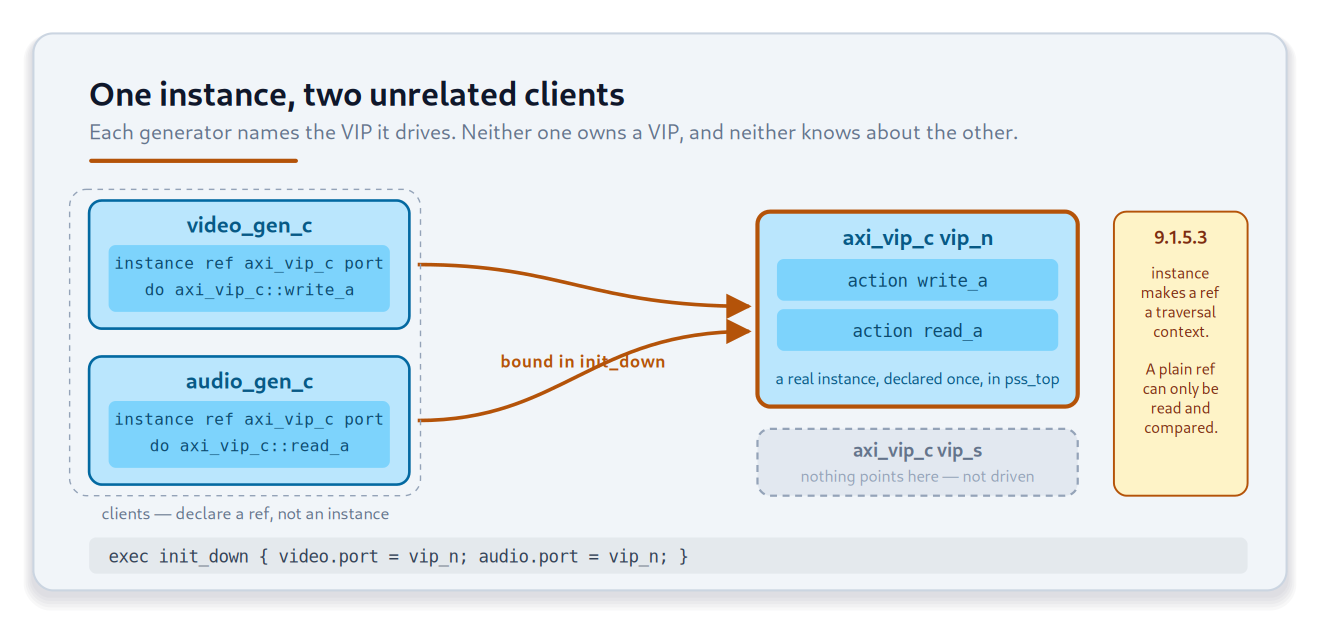
Hierarchical traffic generation is the case that motivates this. You have a set of traffic-generation components – per-protocol, per-workload, written by different people at different times – and a single VIP that all of it has to go through. Pre-3.1, the component tree forces a choice: the VIP is declared inside exactly one place, and every client that wants to traverse VIP actions has to live somewhere that makes that instance reachable. The declaration site is the wiring.
component axi_vip_c {
    action write_a { rand bit[64] addr; rand int in [1..64] len; }
    action read_a  { rand bit[64] addr; rand int in [1..64] len; }
}

component video_gen_c {
    instance ref axi_vip_c port;

    action stream_a {
        activity {
            repeat (8) { do axi_vip_c::write_a; }
        }
    }
}

component audio_gen_c {
    instance ref axi_vip_c port;

    action stream_a {
        activity {
            repeat (4) { do axi_vip_c::read_a; }
        }
    }
}

component pss_top {
    axi_vip_c   vip_n, vip_s;
    video_gen_c video;
    audio_gen_c audio;

    exec init_down {
        video.port = vip_n;   // both clients share the north port ...
        audio.port = vip_n;   // ... and neither had to say so itself
    }

    action test {
        activity {
            parallel {
                do video_gen_c::stream_a;
                do audio_gen_c::stream_a;
            }
        }
    }
}
Each generator declares that it drives an axi_vip_c. Which one is decided
in init_down, at the level that actually knows the topology. That’s the win:
it decouples clients from instances, so the same generator component drops into
a system with one VIP, four VIPs, or a VIP that lives three levels away.
Worth knowing (9.1.5.3):
instanceis what buys the traversal context. An unqualifiedrefis still useful – you can compare it and read through it – butxfer_acannot run on it.- An
instance refcan be a list.instance list<ref chan_c> spares;gives you a set of traversal contexts whose membership is decided at initialization. - Static pool-binding directives do not apply to instance refs. Bind directives are evaluated statically, and refs are connected during the initialization stage. Consequently, it’s illegal to apply bind directives to an instance component ref.
- Reference cycles are permitted when a component ref is used from procedural code, but shall not exist among the refs used as action-traversal contexts.
- Instance refs of address-space and executor types have the same capabilities as instance fields of those types – which is what makes shared-address-space and shared-executor topologies expressible the same way.
Application 2: decoupling the action interface from its implementation
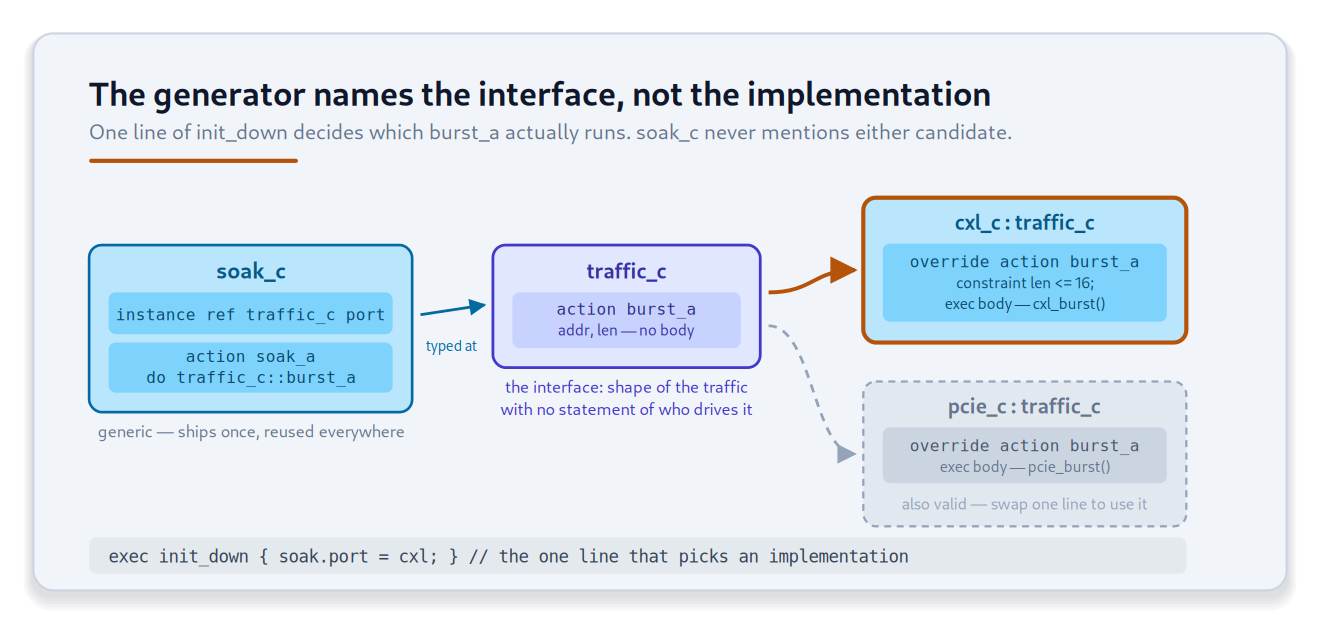
Many of those traffic generators are quite generic. A soak loop that issues
bursts at random addresses doesn’t care whether the bursts land on CXL or PCIe
– and, more to the point, we don’t want it to have to name whoever
implements them. Pair an instance ref typed at a base component with 3.1’s
override action, and it’s easy to separate the interface and the implementation.
// The interface: what traffic looks like, with no statement of who drives it.
component traffic_c {
    action burst_a {
        rand bit[64]        addr;
        rand int in [1..64] len;
    }
}

// Two realizations.
component pcie_c : traffic_c {
    override action burst_a {
        exec body C = """
            pcie_burst({{addr}}, {{len}});
        """;
    }
}

component cxl_c : traffic_c {
    override action burst_a {
        constraint len <= 16;
        exec body C = """
            cxl_burst({{addr}}, {{len}});
        """;
    }
}

// A generic generator. It knows traffic_c, and nothing else.
component soak_c {
    instance ref traffic_c port;

    action soak_a {
        activity {
            repeat (8) { do traffic_c::burst_a; }
        }
    }
}

component pss_top {
    pcie_c pcie;
    cxl_c  cxl;
    soak_c soak;

    exec init_down {
        soak.port = cxl;   // one line decides which burst_a runs
    }

    action test {
        activity {
            do soak_c::soak_a;
        }
    }
}
soak_a traverses traffic_c::burst_a and gets whichever burst_a the bound
component actually provides – including cxl_c’s extra constraint len <= 16,
which the generator never has to know about. Specifying the specific implementation
for traffic-generation actions is controlled with a single component-ref assignment.
Worth knowing (9.1.5.3 + 9.2.2):
- An
override actionis virtual with respect to the component it’s declared in; the implementation is chosen by the component context the action is traversed in. An overriding action implicitly inherits from the action it overrides. - A ref typed at a base component and bound to a derived instance is a valid traversal context for the derived component’s additional actions too, not just the inherited ones (LRM Example 53). The reference’s declared type sets a floor, not a ceiling.
override actionrequires a same-named action in a base component, and once a component declares one, every subtype declaring that name must also mark itoverride. Template actions can’t be overridden.- Note that this is a different mechanism from 3.0’s
override { type ... }blocks. Those replace a declared type wholesale;override actionresolves per component instance. Both are still in 3.1 and they compose. - Null is a real state. A traversal context must be non-null, so an unbound
instance refis a scenario that can’t elaborate. Decide deliberately whether an unbound port means “not present” or “integration bug”, and check for it where you can produce a better message than the tool will.
Conclusions and providing feedback
Composition may seem like the least interesting of the four PSS 3.1
feature groups, but it actually adds significant new modeling and
reuse capabilities. Action initialization and
action-handle arrays make activities read like what they are. mutable gives
a component somewhere to keep activity-model state. And instance
component references break the link between where a component is declared and
who is allowed to traverse its actions – which is the difference between a
model you ship and a model somebody else extends.
Here’s what I’d suggest thinking about while reading Clause 9 and Clause 11 of the draft:
-
Take the component you’d most like to reuse and try to re-express its wiring with
instance ref. Does the behavior partition the way you want? What about the restriction on static binding? Are there scenarios where that creates a problem? -
Where does
mutableneed ordering guarantees it doesn’t have? Atomicity without a defined solve order is enough for accumulators and not much else. If you have a use case that needs more, describe it concretely; it’s the kind of input that shapes the next release. -
Try initializing something the rules don’t allow. The
pre_solve/post_solveaccessibility pair in 11.3.1.2 is deliberately narrow. Find the case where you want to pass data and cannot. -
Check the boundaries of whole-array traversal. 11.3.2 forbids an initializer list or in-line constraint on an array traversal. Does that leave you a workable way to express what you wanted?
It takes a community to build a standard, and your eyes and attention are a much-appreciated contribution! The review closes at the end of September.
References
- Feedback Forum
- PSS 3.1 Draft
- Post 1: PSS 3.1 Is Out for Public Review
- Post 2: Simplifying Constraint Modeling