PSS 3.1 Is Out for Public Review -- Here's What Changed
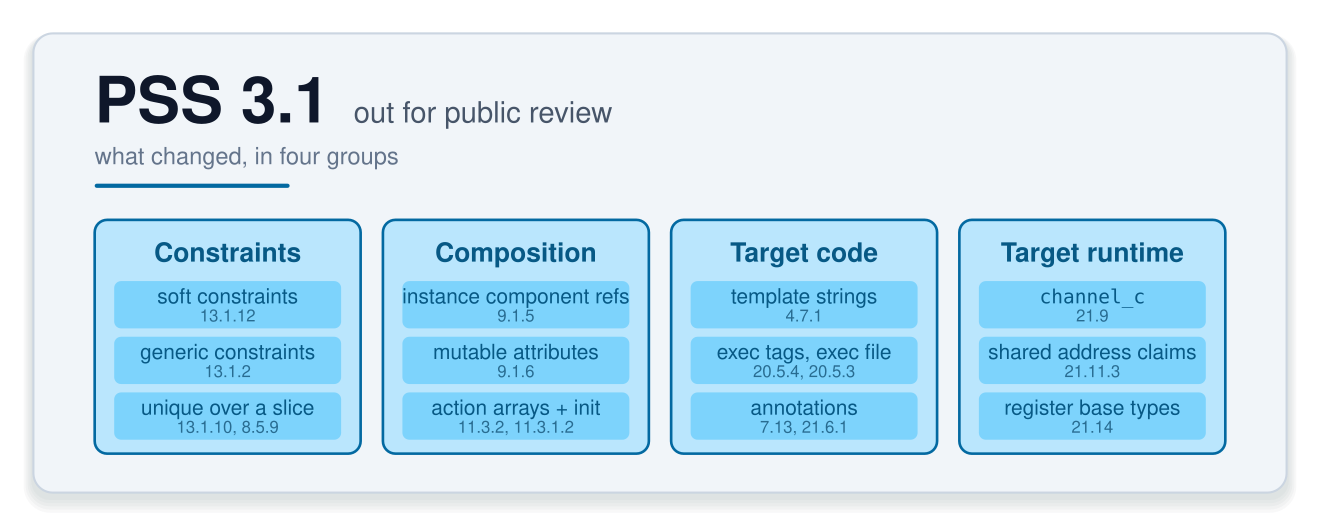
After roughly two years of work, the Accellera Portable Stimulus Working Group (PSWG) released PSS 3.1 for public review. PSS 3.1 is a so-called ‘minor’ release, which is always a bit subjective. PSS 3.1 doesn’t introduce major new features, the way that PSS 3.0 introduced behavioral coverage. But, it does introduce new features that enable modeling scenarios that were previously impossible, and simplify things that were previously possible by clunky or inconvenient. The PSWG is looking for feedback by the end of September, so the clock is ticking. Let’s dig in to survey the broad categories of change in PSS 3.1.
Every new release of a standard contains a variety of features. With major release, we can point to a small number of headline features. With a minor release like 3.1, it’s helpful to organize the new features into categories. The banner does a good job of listing four categories of new feature. Over the next few posts, we’ll dig into each category in more detail. For now, let’s get the lay of the land.
Constraints
struct xfer_s {
    rand bit[64] src_addr, dst_addr;
    rand int     access_sz;

    constraint aligned(bit[64] a, int n) { a % n == 0; }

    constraint c {
        access_sz in [1,2,4,8];
        aligned(src_addr, access_sz);
        aligned(dst_addr, access_sz);
    }
}
PSS scenario models use constraints heavily to capture data-value and scheduling rules of the test scenario. PSS started out with the bulk of the constraint features that SystemVerilog supports. 3.1 adds support for soft constraints, but also adds a new type of constraint designed for reuse: generic constraints. Think of generic constraints as the constraint equivalent of functions – very helpful when you want to express the same relationship multiple times across different variables.
Composition
instance ref chan_c       primary;
instance list<ref chan_c> spares;
ref chan_c                observer;

mutable int bytes_moved;
PSS uses structure, in the form of the component tree, as a location. PSS 3.1 adds several new structural capabilities – including mutable data that activities can use during the solve phase and using component-reference fields as action context in activities.
Target code
exec body C = """
    {# One program call per chunk, then start the engine. #}
    {% foreach (c : chunk[0..nchunks-1]) %}
    dma_program_chunk({{c}});
    {%%}
    {% if (irq) %}
    dma_enable_irq();
    {%%}
    dma_start();
""";
PSS continues to support text generation as a mechanism for realizing tests. New controls have been added to support greater control over the generated output.
Target runtime
channel_c<desc_s, 4> descq;

action consume_a {
    exec body {
        desc_s d;
        // Blocks until an element is available; FIFO order.
        d = comp.descq.get();
        message(LOW, "programmed a descriptor");
    }
}
PSS 3.1 introduces two new capabilities for runtime interaction. Channels provide a mailbox for passing data between threads within a PSS scenario, or between PSS scenario threads and the environment. A new ‘export function’ feature provides a way for the environment call into a PSS test – for example, to notify of an interrupt.
Conclusion and next steps
PSS 3.1 has a wealth of new features and improvements to existing features, and we’ll start looking in more depth at the features in each category in future posts. The public review period for PSS 3.1 extends through the end of September. Read the LRM draft and provide feedback via the Accellera 3.1 Feedback Forum!