
Relating Hardware Model Abstractions
18 Jan 2026
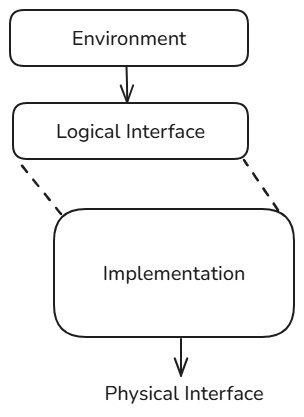
The most difficult transition in hardware modeling is the transition from natural-language to executable specification. It is during this transition that the ambiguities inherent in natural-language descriptions are resolved. Maximizing value from a multi-abstraction hardware modeling strategy requires minimizing the number of times a natural-language spec is converted to executable. Zuspec defines interface abstraction levels that provide a basis for comparing implementations with different abstraction levels.
Connecting Modeling Abstractions
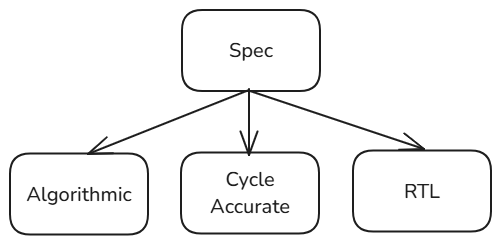
In the previous post, we looked at several internal-implementation abstraction levels. These help us explore the architecture and micro-architecture of the design with different cost and performance tradeoffs. However, the internal implementation doesn’t provide a good basis for comparing models. In essence, this means that the natural-language to executable spec translation happens for each model. This raises the cost of modeling, but also increases the risk that each model implements a slightly different interpretation of the original spec.
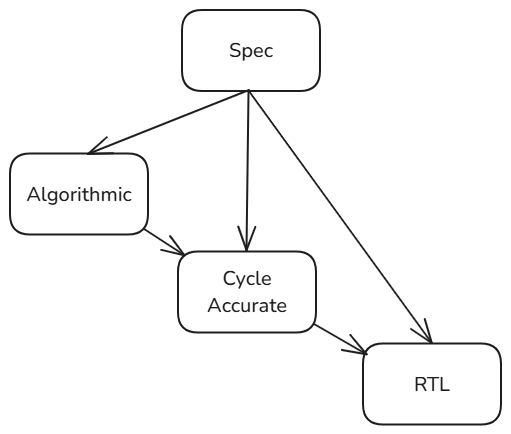
Ideally, we want some basis for mechanically comparing two models with different implementations such that we can easily establish whether they are equivalent according to that basis. Each model still needs to incorporate abstraction-specific details from the spec, but isn’t a full from-spec implementation.
Breaking Down Device Abstraction
Zuspec uses interface abstraction levels as this basis of comparison. The first thing to note is that there are two levels of interface: logical and physical.
The same set of interface abstractions apply to logical and physical interfaces, so let’s explore the abstraction levels first.
Abstraction: Scenario
A scenario-level interface captures rules about how a device may be used. The Portable Test and Stimulus (PSS) standard is likely the best-known example of a scenario-level interface abstraction. PSS uses scheduling rules and constraints to specify data, data-flow, and resource utilization rules. The rules of a scenario-level description assist in automating test creation and simplifying the integration of content from multiple IPs.
Abstraction: Operation
An operation-level interface captures the device interface in terms of operations that the device can perform. Think of the API of a software driver for a device. An operation-level interface lets us exercise key functions of a device without worrying too much about the details.
Abstraction: MMIO
A memory-mapped I/O (MMIO) interface uses memory-mapped registers and interrupts as the device interface.
Abstraction: TLM
A transaction-level modeling (TLM) interface uses packet-like messages. The TLM 1.0 and 2.0 standards provide good examples of this level of modeling. TLM is also heavily used in UVM testbench environments.
Abstraction: Protocol
Protocol-level interfaces are the familiar signal-level interfaces used in register-transfer level (RTL) designs.
Physical Interfaces
We’re all familiar with physical device interfaces. In RTL, these are the Protocol-level interfaces with signal-level ports at the boundary of the device. Every hardware model has physical interfaces, and these typically
Logical Interfaces
A logical interface is typically a software interface. Software, firmware, and test environments interact with a device via logical interfaces. A key attribute of a logical interface is that it is independent of the physical interface and can be virtualized.
Useful Combinations
The combination of logical and physical interface abstraction levels, combined with internal implementation abstraction level, provides a flexible way to characterize a given model. The table below summarizes how the abstraction levels apply to logical and physical interfaces.
| Abstraction | Logical | Physical |
|---|---|---|
| Scenario | Yes | Maybe |
| Operation | Yes | Yes |
| MMIO | Yes | Yes |
| TLM | Maybe | Yes |
| Protocol | No | Yes |
Interface Roles
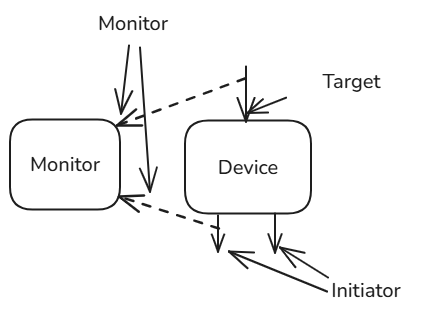
In addition to abstraction level and interface type, interface roles are also worth considering when characterizing a device.
- Initiator interfaces make requests to targets. Think: memory interface on a RISC-V core
- Target interfaces respond to requests from an initiator. Think: register interface on a UART
- Monitor interfaces passively view interaction between initiator and target
Relating Interface Abstractions
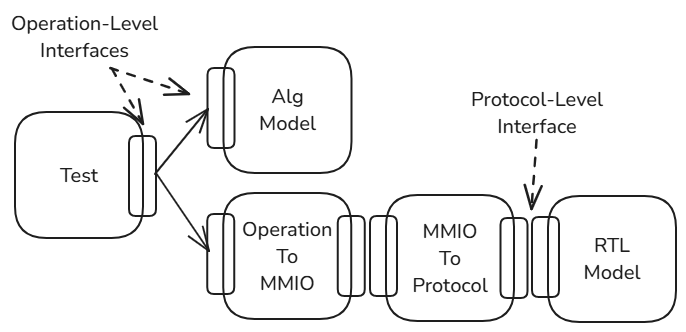
Abstractors, a term used by the IP-XACT standard, provide a mechanism for bridging abstraction levels in a reusable way. An abstractor has two or more physical interfaces with different abstraction levels and different roles. Specific kinds of abstractors often go by names like bus functional model or transactor.
With the right set of abstractors, we can provide multiple views of the same model implementation. For example, an algorithmic implementation of a device with MMIO physical interfaces can be used as a stand-in for the RTL implementation of the device with protocol-level interfaces in a verification testbench simply by adding the right protocol transactors from a library.
Next Steps
Interface abstraction levels and interface types (logical, physical) enable model reuse and provide a basis for comparing models with very different internal implementations. While there are many legal combinations of logical interface, physical interface, and internal implementation, there are a few key combinations. In the next post, we’ll start to look at how some of these key combinations, and how they are captured and evaluated in Zuspec.